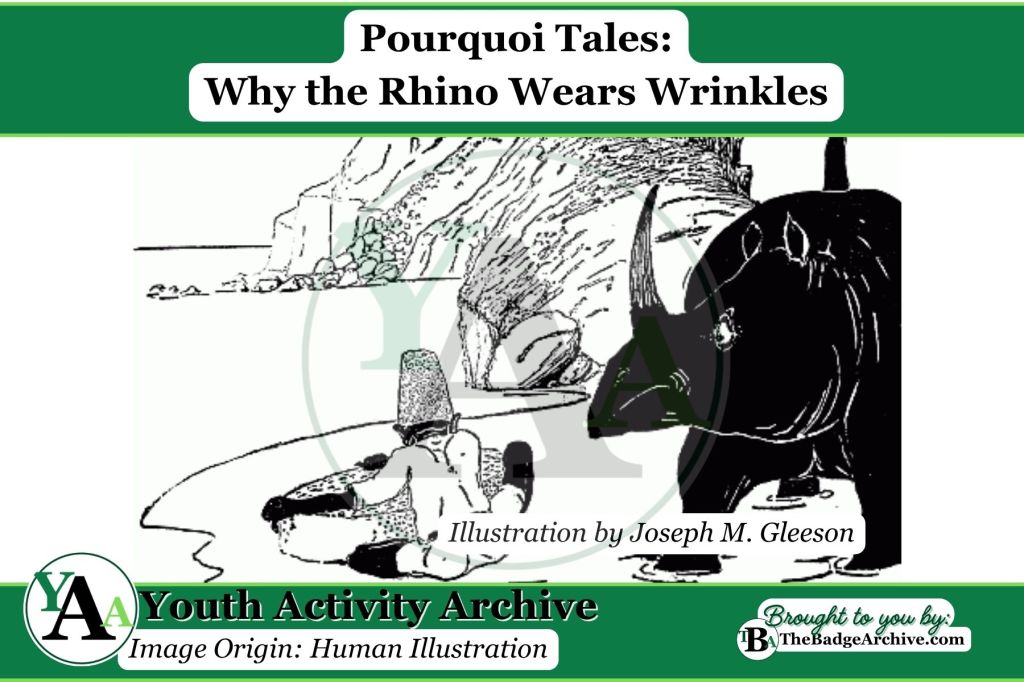
Once upon a time, on a lonely island, there lived a baker who wore a very shiny hat. One day, he made a giant, wonderful cake filled with sugar and raisins. It was two feet wide and three feet thick! But just as he was about to take a bite, a Rhinoceros with very bad manners came out of the jungle.
In those days, the Rhinoceros had smooth skin that fit him perfectly. It didn’t have a single wrinkle. The Rhinoceros was rude, and he didn’t ask to share. He simply spiked the cake on his horn, ate the whole thing, and walked away.
Five weeks later, it became very hot. It was so hot that everyone wanted to go for a swim. The Rhinoceros went down to the beach, took off his skin, and left it on the sand while he splashed in the water. In those days, his skin buttoned up underneath like a raincoat.
The baker found the skin lying there. He smiled a very big smile. He went to his camp and gathered all the dry, stale, tickly cake crumbs and scratchy raisins he could find. He scrubbed and rubbed those crumbs into the Rhinoceros’s skin until it was completely full of them!
When the Rhinoceros came out of the water, he put his skin back on and buttoned it up. Suddenly, he felt a tickle. Then he felt a scratch! It felt like having crumbs in your bed. He wanted to scratch his back, but that only made it worse.
He lay down and rolled on the sand, but the crumbs tickled even more. Then he ran to a palm tree and rubbed himself against the bark. He rubbed so hard and so fast that he rubbed his skin into great big folds and wrinkles. He even rubbed the buttons right off!
By the time he was done, his skin was all baggy and full of folds, but the tickly crumbs were still inside. This made him very grumpy. And that is why, to this very day, every rhinoceros has big folds in his skin and a very bad temper!
About the Original Story
Original Title: “How the Rhinoceros Got His Skin”
From the Book: Just So Stories (1912)
Author: Rudyard Kipling
Type: This story is a Pourquoi Tale , a traditional legend or foundational story focused on explaining the origins of natural phenomena, animal physical traits, or cultural customs. These narratives serve as ancestral records and cultural adaptations that answer “how” or “why” a specific part of the natural world became the way it is today. Pourquoi is the French word for “why.”
History: Rudyard Kipling wrote these stories for his children, using playful language and repetition. This story was included in the 1912 edition published by Doubleday, Page & Company. In the original 1898 text, the baker is called a Parsee named Pestonjee Bomonjee, and the Rhinoceros had skin that buttoned with three buttons. This story was included in the 1912 edition published by Doubleday, Page & Company.
A Parsee (also spelled Parsi) is a member of a Zoroastrian community in India. They are descended from Persian Zoroastrians who emigrated to India to avoid religious persecution following the Arab conquest of Persia in the 7th century.
–
For More Fun Ideas and Plans

Join the Girl Scout Daisy, Brownie, and Junior Leader Help Facebook Group
(Not an official GSUSA Group)

Join the Girl Scout Cadette, Senior, and Ambassador Leader Help Facebook Group
(Not an official GSUSA Group)

See other Recommended Facebook Groups for some Scouting Organizations
(No official Groups)
–
Click Here -> To see information References:
Disclaimer: The information published on Youth Activity Archive and The Badge Archive is built from the references listed below. These sources demonstrate that our content is grounded in facts and research, not opinion or speculation. Readers may consult them directly when looking for additional material.
- Kipling, Rudyard. Just so Stories. Doubleday Page & Company, 1912.
- Found on Gutenberg Library, 17 April 2026: https://www.gutenberg.org/ebooks/32488
- Karaka, Dosabhai Framjee. History of the Parsis: Including Their Manners, Customs, Religion and Present Position. Vol. 1, London, Macmillan & Co., 1884.
- Karaka, Dosabhai Framjee. History of the Parsis: Including Their Manners, Customs, Religion and Present Position. Vol. 2, London, Macmillan & Co., 1884.
- Find out how you can support The Badge Archive!
- See other Pourquoi Tales.