A long time ago, when the world was brand new, the animals were just starting to work with the people. But there was one Camel who was very lazy. He lived in the middle of a hot, sandy desert. He didn’t want to do any work at all. When anyone spoke to him, he just said, “Humph!”
On Monday, the Horse came by with a saddle and said, “Camel, come run and work with us!”
“Humph!” said the Camel.
On Tuesday, the Dog came by with a stick and said, “Camel, come fetch and carry with us!”
“Humph!” said the Camel.
On Wednesday, the Ox came by with a yoke and plow and said, “Camel, come help us farm!”
“Humph!” said the Camel.
Because the Camel wouldn’t help, the other animals had to work twice as hard. They were very upset. The along came the Djinn, a magical spirit of the desert. He arrived in a big cloud of dust as only magical spirits do. The animals told him about the lazy Camel.
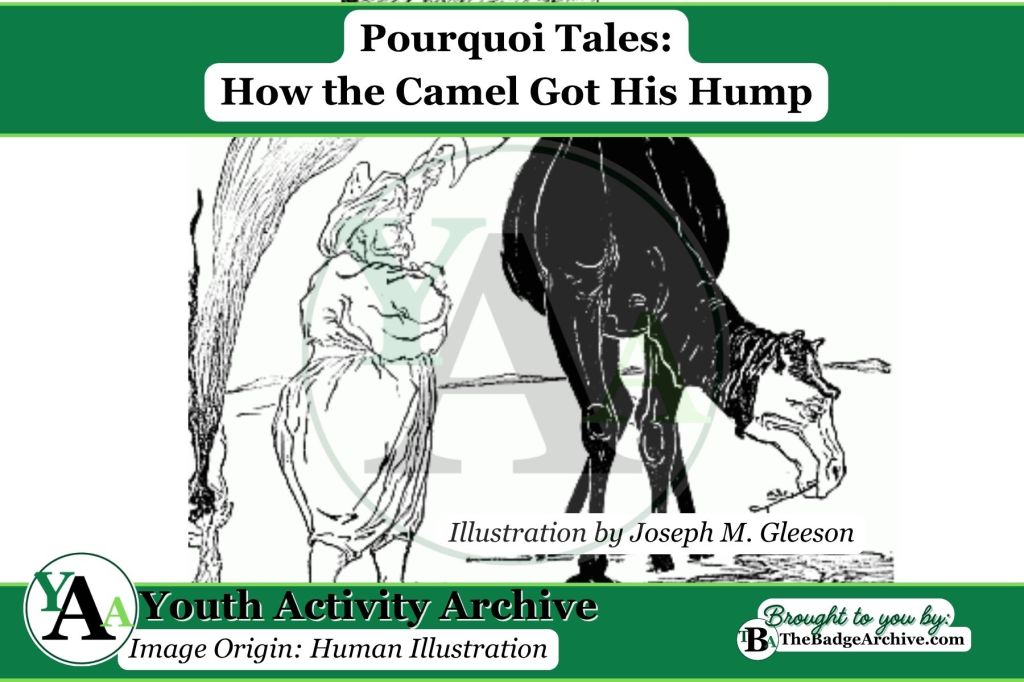
The Djinn found the Camel looking at his own reflection in a pool of water, feeling very proud of himself.
“My friend,” said the Djinn, “why are you sitting here while the others do all the work? For three days, all of Monday, Tuesday, and Wednesday, the Horse, the Dog, and the Ox have been working extra hard. Just so you could sit and be lazy. It is not fair to leave your work for them to do.”
“Humph!” said the Camel.
“I am not here to argue,” the Djinn said. “If you do not help, the work will never be finished.”
“Humph!” said the Camel.
“I wouldn’t say that word again if I were you. You have already said it once too often,” the Djinn warned.
“Humph!” the Camel said once more.
As soon as he said it, he saw his beautiful back begin to puff up. It grew and grew into a giant, wobbly mound.
“Do you see that?” asked the Djinn. “That is your very own ‘Humph’ that you brought on yourself by being lazy. Now you must work.”
“How can I work with this big thing on my back?” asked the Camel.
“That ‘Humph’ is there for a reason,” said the Djinn. “It will help you to work for three days without stopping to eat. You are finally going to help the others.”
The Camel went to join the other animals, and he has worn that hump ever since. We call it a “hump” now so we don’t hurt his feelings, but he is still a little bit grumpy. He still hasn’t finished the work he missed at the beginning of the world.
About the Original Story
Original Title: “How the Camel Got His Hump”
From the Book: Just So Stories (1912)
Author: Rudyard Kipling
Type: This story is a Pourquoi Tale, a traditional legend or foundational story focused on explaining the origins of natural phenomena, animal physical traits, or cultural customs. These narratives serve as ancestral records and cultural narratives that answer “how” or “why” a specific part of the natural world became the way it is today. Pourquoi is the French word for “why.”
History: Rudyard Kipling wrote these stories for his children, using playful language and repetition. In the original 1897 text, the “Magical Spirit” is called a Djinn, and the story explains that the “humph” became a permanent physical trait because of the animal’s attitude. It was included in the 1912 edition published by Doubleday, Page & Company.
–
For More Fun Ideas and Plans

Join the Girl Scout Daisy, Brownie, and Junior Leader Help Facebook Group
(Not an official GSUSA Group)

Join the Girl Scout Cadette, Senior, and Ambassador Leader Help Facebook Group
(Not an official GSUSA Group)

See other Recommended Facebook Groups for some Scouting Organizations
(No official Groups)
–
Click Here -> To see information References:
Disclaimer: The information published on Youth Activity Archive and The Badge Archive is built from the references listed below. These sources demonstrate that our content is grounded in facts and research, not opinion or speculation. Readers may consult them directly when looking for additional material.
- Kipling, Rudyard. Just so Stories. Doubleday Page & Company, 1912.
- Found on Gutenberg Library, 17 April 2026: https://www.gutenberg.org/ebooks/32488
- Find out how you can support The Badge Archive!
- See other Pourquoi Tales.