In the days when the world was brand new, the Leopard lived in a place called the High Veldt. It was a very hot, very sandy, and very yellow place. There was sandy-yellow rock and sandy-yellow grass. The Leopard was the sandiest-yellowest-brownest cat you ever did see. He matched the rocks and the grass so well that he could hide just by sitting still.
But then, the Giraffe and the Zebra moved away. They went to a great big forest. The tree trunks were all speckly and spottly, dotted and dappled, splashed, slashed and criss-crossed with shadows.
The Leopard was left all alone in the yellow dust, and his tummy began to grumble. Rumble, bumble, grumble! He went to see Baviaan, the dog-headed Baboon, who was the wisest animal in all of South Africa.
“Baviaan,” said the Leopard, “where has all my dinner gone?”
Baviaan winked his eye and said, “The game has gone into other spots. And my advice to you, Leopard, is to go into other spots as soon as you can.”
“That is very confusing,” said the Leopard. “What do you mean by ‘other spots’?”
“I mean what I say,” barked Baviaan. “The world has changed! If you want to find your breakfast, you must change, too.”
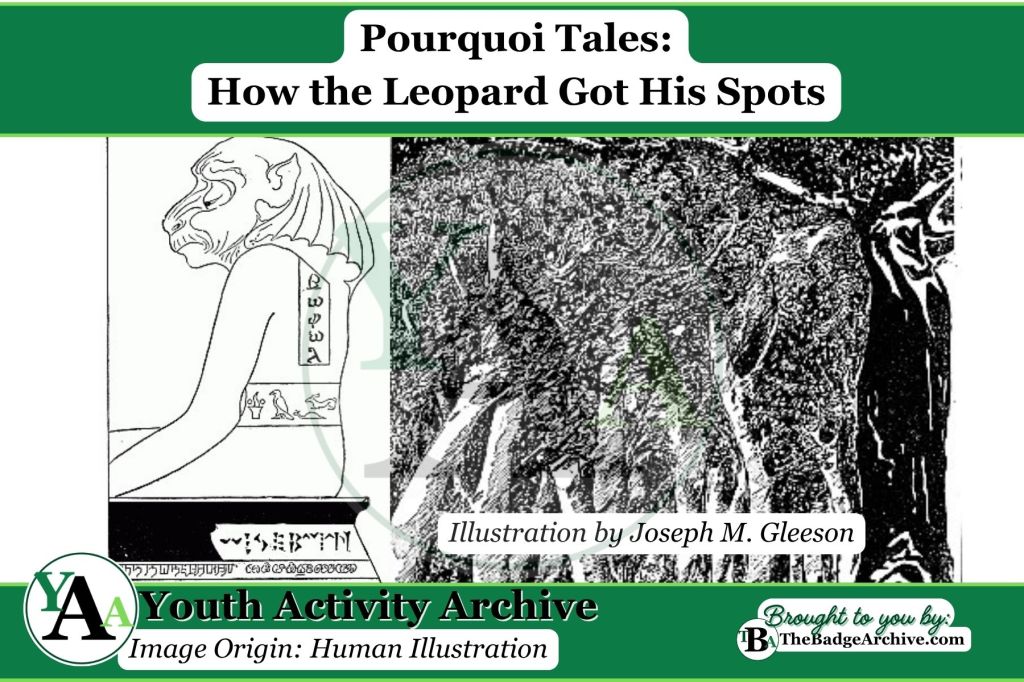
The Leopard traveled for many days until he reached a forest. The tree trunks were all speckly and spottly, dotted and dappled, splashed, slashed and criss-crossed with shadows. He could smell the Zebra and he could hear the Giraffe, but he could not see them at all!
Suddenly, he jumped at a sound and caught a thing that felt like a Zebra. But it didn’t look like a Zebra.
“Wait a minute,” said the Leopard. “I remember you from the High Veldt. Back then, you were one color, a soft, light brownish-gray. Why are you covered in these purple and black stripes?”
“Because we aren’t on the High Veldt anymore!” the Zebra laughed. “In this forest, stripes are the best way to hide. Let me up and I’ll show you.”
The Leopard let him up. The Zebra ran into the stripy shadows of some thorn bushes and—Zip!—he vanished. “One, two, three! Where’s your lunch?” called the Zebra’s voice from the trees. The tree trunks were all speckly and spottly, dotted and dappled, splashed, slashed, and criss-crossed with shadows.
The Leopard waited until the sun went down and the forest became very, very dark. He couldn’t see his own paws! Suddenly, he heard a sniff-sniff-sniff in the starlight. He jumped! He caught a thing that smelled like Giraffe and kicked like Giraffe, but it was so dark he couldn’t see a thing.
“Be quiet, you mystery-person without any shape!” the Leopard said. “I am going to sit on your head until morning, because there is something about you I do not understand.”
So he sat and waited. When the bright morning sun finally poked through the leaves, the Leopard looked down and gasped.
“What in the world happened to you?” the Leopard cried. He looked at the animal. “I remember you from the High Veldt! Back then, you were seventeen feet of plain, bright lion-gold fur. But now you are covered in big, brown blotches! How did you change your clothes, Giraffe?
“The shadows of the tall trees fell on me and made me blotchy,” the Giraffe explained. “If you me up, I will show you the magic trick.”
The Leopard let him go. The Giraffe waddled into the tall trees and—Zap!—he was gone. “One, two, three! Where’s your breakfast?” called the Giraffe from the leaves. The tree trunks were all speckly and spottly, dotted and dappled, splashed, slashed, and criss-crossed with shadows.
The Leopard sat down and talked to himself. “This is a problem,” he whispered. “I show up in this dark forest like a bright yellow sun against a black shadow. Zebra has stripes. Giraffe has blotches. If I stay plain yellow, I will never have dinner again. I remember what Baviaan said. He told me to go into spots.”
He looked at a nearby tree and saw a branch that had five little tips at the end. He saw a patch of thick, dark forest mud.
“I shall make my own spots!” the Leopard said.
He dipped the five-fingered branch into the dark mud and pressed it against his fur. Press, dot, spot! He did it again and again. Sometimes the branch slipped and the marks got a little smudged, but he didn’t mind. Everywhere the five fingers touched, they left five little black marks close together.
“Now I am a beauty!” the Leopard purred. “I can lie on a branch and look like sunshine sifting through the leaves. I can lie on the rocks and look like a pile of pebbles.”
He went into the shadows and disappeared just like his friends. And from that day to this, the Leopard has always kept his beautiful spots with the tree trunks that were all speckly and spottly, dotted and dappled, splashed, slashed, and criss-crossed with shadows!
About the Original Story
Original Title: “How the Leopard Got His Spots”
From the Book: Just So Stories (1912)
Author: Rudyard Kipling
Type: This story is a Pourquoi Tale , a traditional legend or foundational story focused on explaining the origins of natural phenomena, animal physical traits, or cultural customs. These narratives serve as ancestral records and cultural adaptations that answer “how” or “why” a specific part of the natural world became the way it is today. Pourquoi is the French word for “why.”
History: Rudyard Kipling wrote these stories for his children, using playful language and repetition. In the original 1901 text, the leopard’s spots were created by the black fingerprints of a human hunter. This modernized version replaces the human character with a branch that had five little tips at the end and forest mud to make the story appropriate for a modern kindergarten audience while still explaining why leopard rosettes often look like a cluster of five marks.
–
For More Fun Ideas and Plans

Join the Girl Scout Daisy, Brownie, and Junior Leader Help Facebook Group
(Not an official GSUSA Group)

Join the Girl Scout Cadette, Senior, and Ambassador Leader Help Facebook Group
(Not an official GSUSA Group)

See other Recommended Facebook Groups for some Scouting Organizations
(No official Groups)
–
Click Here -> To see information References:
Disclaimer: The information published on Youth Activity Archive and The Badge Archive is built from the references listed below. These sources demonstrate that our content is grounded in facts and research, not opinion or speculation. Readers may consult them directly when looking for additional material.
- Kipling, Rudyard. Just so Stories. Doubleday Page & Company, 1912.
- Found on Gutenberg Library, 17 April 2026: https://www.gutenberg.org/ebooks/32488
- Karaka, Dosabhai Framjee. History of the Parsis: Including Their Manners, Customs, Religion and Present Position. Vol. 1, London, Macmillan & Co., 1884.
- Karaka, Dosabhai Framjee. History of the Parsis: Including Their Manners, Customs, Religion and Present Position. Vol. 2, London, Macmillan & Co., 1884.
- Find out how you can support The Badge Archive!
- See other Pourquoi Tales.