In the High and Far-Off Times, the Elephant, had no trunk. He only had a blackish, bulgy nose, as big as a boot, that he could wriggle about from side to side. He couldn’t pick anything up with it.
But there was one new Elephant, an Elephant’s Child, who was full of huge, big curiosity, and that means he asked ever so many questions!
He asked his tall aunt, the Ostrich, “Why do your tail feathers grow just like that?” And his tall aunt the Ostrich gave him a gentle shushing-tap with her hard, hard claw.
But still, he was full of curiosity!
He asked his tall uncle, the Giraffe, “What makes your skin so spotty?” And his tall uncle the Giraffe gave him a gentle shushing-tap with his hard, hard hoof.
And still, he was full of curiosity!
He asked his broad aunt, the Hippopotamus, “Why are your eyes so red?” And his broad aunt the Hippopotamus gave him a gentle shushing-tap with her broad, broad hoof.
And still, he was full of curiosity!
He asked his hairy uncle, the Baboon, “Why do melons taste just like this?” And his hairy uncle the Baboon gave him a gentle shushing-tap with his hairy, hairy paw.
And still, he was full of curiosity!
He asked questions about everything that he saw, or heard, or felt, or smelt, or touched, and all his uncles and his aunts gave him a gentle shushing-tap.
But still, he was full of curiosity!
One fine morning, this curious Elephant’s Child asked a brand-new fine question that he had never asked before. He asked, “What does the Crocodile have for dinner?”
Then everybody said, “Hush!” in a loud and dreadful tone, and they gave him a long, long shushing-tap immediately and directly, without stopping.
But the Elephant’s Child still wanted to know. He met the Kolokolo Bird, who told him, “Go to the banks of the great grey-green, greasy Limpopo River, all set about with fever-trees, and find out.”
The Elephant’s Child packed a hundred pounds of bananas, a hundred pounds of sugar cane, and seventeen melons. He said goodbye to his family and headed off to find the river.
He had never seen a Crocodile before and didn’t know what one looked like. On the riverbank, he met a Big Colorful Snake wrapped around a rock.
“Excuse me,” said the Elephant’s Child politely, “but have you seen a Crocodile?”
“Have I seen a Crocodile?” asked the Snake. “What will you ask me next?”
“I want to know what he has for dinner,” said the Elephant’s Child.
The Snake just shook his head and gave the Elephant’s Child a little tap with his tail to shush him and sent him on his way.
The Elephant’s Child kept walking until he stepped on what he thought was a log of wood. But it wasn’t a log. It was the Crocodile!
“Excuse me,” said the Elephant’s Child, “but have you seen a Crocodile?”
The Crocodile winked one eye. “Come closer, Little One,” said the Crocodile, “Why do you ask these things?”
“Excuse me,” said the Elephant’s Child, “but all have shushed me whenever I have asked and I don’t wish to be shushed again.”
“Come closer, Little One,” said the Crocodile, “for I am the Crocodile.” He wept crocodile-tears to show it was true.
The Elephant’s Child got very excited. “You are the one I am looking for! Please tell me, what do you have for dinner?”
“Come closer, Little One,” whispered the Crocodile, “and I’ll whisper it to you.”
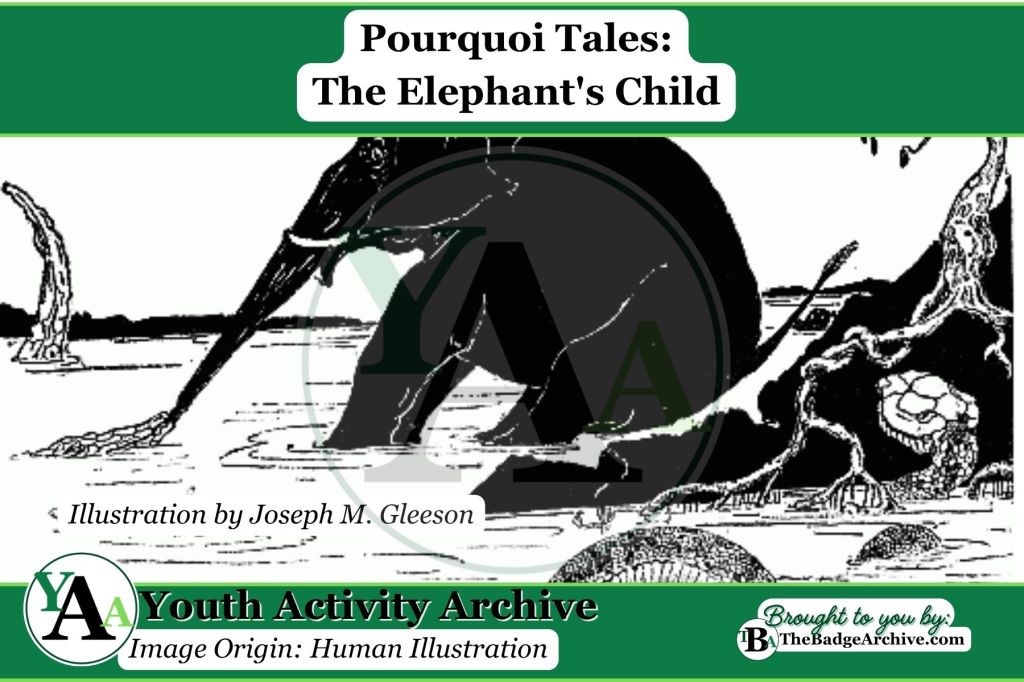
The Elephant’s Child put his head down near the Crocodile’s mouth. Suddenly—SNAP!—the Crocodile caught the Elephant’s Child by his little boot-nose.
“I think,” said the Crocodile between his teeth, while holding the little boot-nose, “that today I will start my dinner with an Elephant’s Child!”
“Let go!” cried the Elephant’s Child through his squashed nose. “You are hurting me!”
The Big Colorful Snake came upon the two and called out to the Elephant’s Child. “Pull, my young friend! Pull with all your might, or that log headed bully will pull you into the stream before you can ask anymore silly questions.”
The Elephant’s Child sat back on his haunches and pulled, and pulled, and pulled. And his nose began to stretch!
The Crocodile pulled, and pulled, and pulled as he scuttled into the water. The Elephant’s Child’s nose grew longer and longer.
The Elephant’s Child spread all four little legs and pulled, and pulled, and pulled. And his nose kept stretching!
The Crocodile thrashed his tail back and forth as he pulled, and pulled, and pulled. The Elephant’s Child’s nose grew longer and longer. It hurt so much!
Then the Elephant’s Child felt his legs slipping. He cried with his munched nose, “This is too much for me!”
The Big Colorful Snake slithered over and tied himself in a double clove hitch knot around the Elephant’s Child’s legs. “Such a foolish young friend I have. It is time for a very big tug! If we do not pull as hard as we can, that scaly, armor-plated snapping-machine will pull you into the deep water and end your adventures forever.”
The Snake pulled and the Elephant’s Child pulled and the Crocodile pulled. But the Elephant’s Child and Snake pulled harder still.
Finally, the Crocodile let go with a loud plop! The Elephant’s Child sat down and said a careful “Thank You,” to the Snake.
Then the Elephant’s Child wrapped his poor nose in cool banana leaves and hung it in the cool water.
“What are you doing?” asked the Snake.
“Excuse me,” said the Elephant’s Child. “My nose is so out of shape. I’m waiting for it to shrink.”
“You will have to wait a very long time,” said the Big Colorful Snake. “Some people do not know what is good for them.”
The Elephant’s Child waited three days, but the nose never shrunk. It stayed a long, beautiful trunk. At the end of the third day, a fly came and stung him on the shoulder. Before he knew what he was doing, he lifted up his trunk and hit that fly with the end of it.
“There you go,” said the Snake. “You couldn’t have done that with that small nose before. Will you try and eat a little now?”
The Elephant’s Child was so hungry, he didn’t think before reaching over to a large bundle of grass with his trunk. He plucked it, dusted it, and stuffed it into his own mouth.
“There you go,” said the Snake. “You couldn’t have done that with that small nose before. Now, don’t you think the sun is very hot here?”
“It is,” said the Elephant’s Child. Before he thought it through, he reached down into he mud with his trunk, scooped some up and slapped it on the back of his head. The cool wet mud felt so nice and trickly behind his ears.
“There you go,” said the Snake. “You couldn’t have done that with that small nose before. Now, would you like to be poked again?”
“Excuse me,” said the Elephant’s Child. “I would not like that at all.”
“Would you like to poke someone?” asked the Snake.
“I would like that a lot,” said the Elephant’s Child.
“Well,” said the Big Colorful Snake. “You should find the new nose of yours very useful indeed my young friend.”
“Thank you,” said the Elephant’s Child. “I’ll remember that. For now, I think I’ll go home to my family.”
The Elephant’s Child was very happy. When he wanted fruit, he could pull it down from the tree instead of waiting for them to fall like before.
When he wanted grass, he could pluck it up with going down on his knees all the time.
When flies came near, he could break off a tree branch and whisk them away.
When he was hot, he could make himself a new cool slushy mud cap anytime he wanted.
When he was lonely, he could sing down his trunk, louder than a brass band.
When he saw his broad aunt, the Hippopotamus, she asked “What happened to your nose?” He happily poked her on the forehead and shushed her before continuing on his way.
When he met his family, he kept his nose curled up. They scolded him for leaving and when his two brothers came forward to poke and shush him, he uncurled his long trunk. They paused, giving him the chance to poke their foreheads.
“I don’t think you all know anything about poking people. But I do.”
His brothers were head over heels. “Oh Bananas! How did you learn that trick? What did you do with your nose?”
“I got a new one from the Crocodile I met,” said the Elephant’s Child. “I asked him what he had for dinner and he gave me this to keep.”
“It looks strange,” said his hairy uncle, the Baboon.
“It does,” agreed the Elephant’s Child. “But it is very useful.” He picked his uncle, the Baboon, up by one hairy leg and raised him up high.
His family was very surprised. He showed his family how useful his new trunk was. Soon, all the other elephants went to the river to get their own long noses, too. When they came back, no one shushed anyone again, but all Elephants you will ever see have trunks just like the Elephant’s Child.
About the Original Story
Original Title: “The Elephant’s Child”
From the Book: Just So Stories (1912)
Author: Rudyard Kipling
Type: This story is a Pourquoi Tale , a traditional legend or foundational story focused on explaining the origins of natural phenomena, animal physical traits, or cultural customs. These narratives serve as ancestral records and cultural adaptations that answer “how” or “why” a specific part of the natural world became the way it is today. Pourquoi is the French word for “why.”
History: Originally published in 1902, this story explains how the elephant’s trunk was created through a tug-of-war with a crocodile. This modernized version replaces the original “spanking” with a “shushing-tap” and “poking,” focusing on the social dynamic of being shushed for asking questions. It maintains the famous description of the “great grey-green, greasy Limpopo River, all set about with fever-trees.”
–
For More Fun Ideas and Plans

Join the Girl Scout Daisy, Brownie, and Junior Leader Help Facebook Group
(Not an official GSUSA Group)

Join the Girl Scout Cadette, Senior, and Ambassador Leader Help Facebook Group
(Not an official GSUSA Group)

See other Recommended Facebook Groups for some Scouting Organizations
(No official Groups)
–
Click Here -> To see information References:
Disclaimer: The information published on Youth Activity Archive and The Badge Archive is built from the references listed below. These sources demonstrate that our content is grounded in facts and research, not opinion or speculation. Readers may consult them directly when looking for additional material.
- Kipling, Rudyard. Just so Stories. Doubleday Page & Company, 1912.
- Found on Gutenberg Library, 17 April 2026: https://www.gutenberg.org/ebooks/32488
- Find out how you can support The Badge Archive!
- See other Pourquoi Tales.