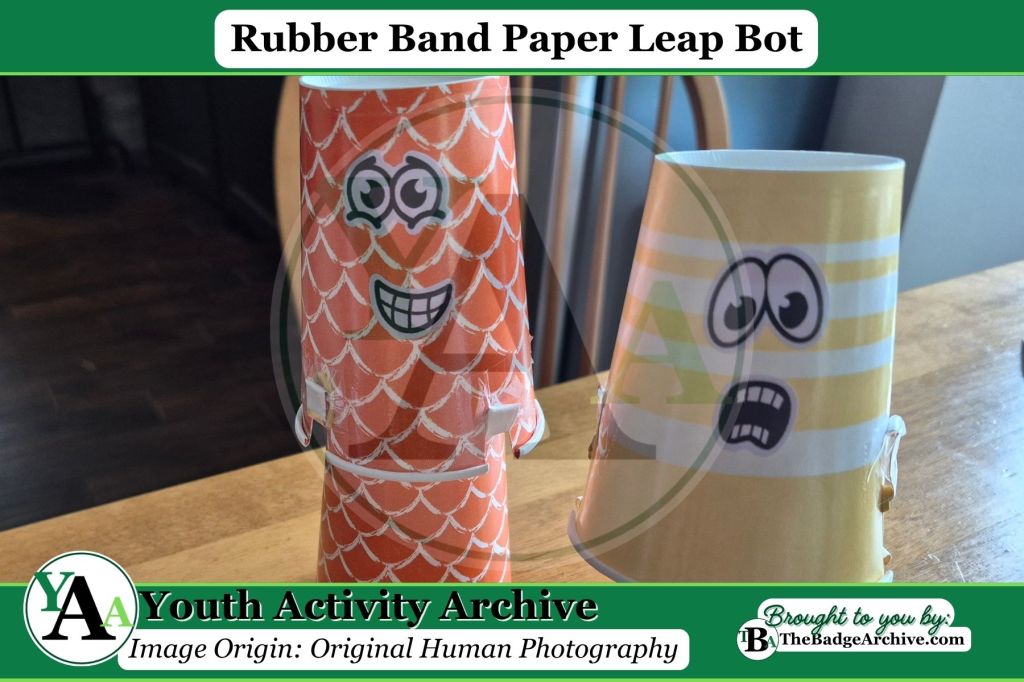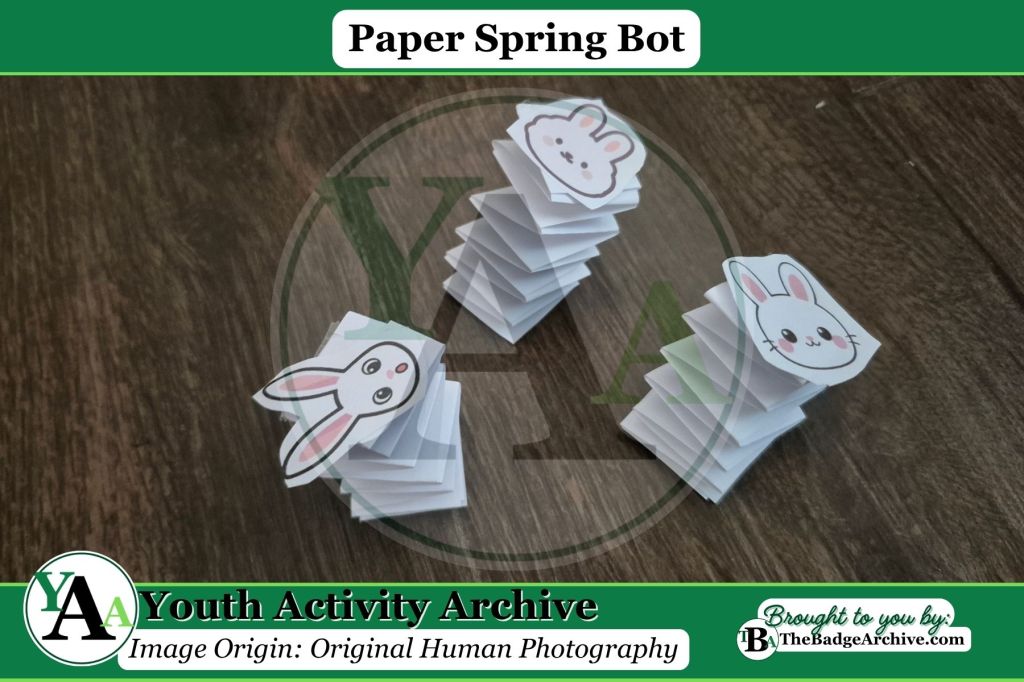
Paired with a movement game of a two-scout chase.
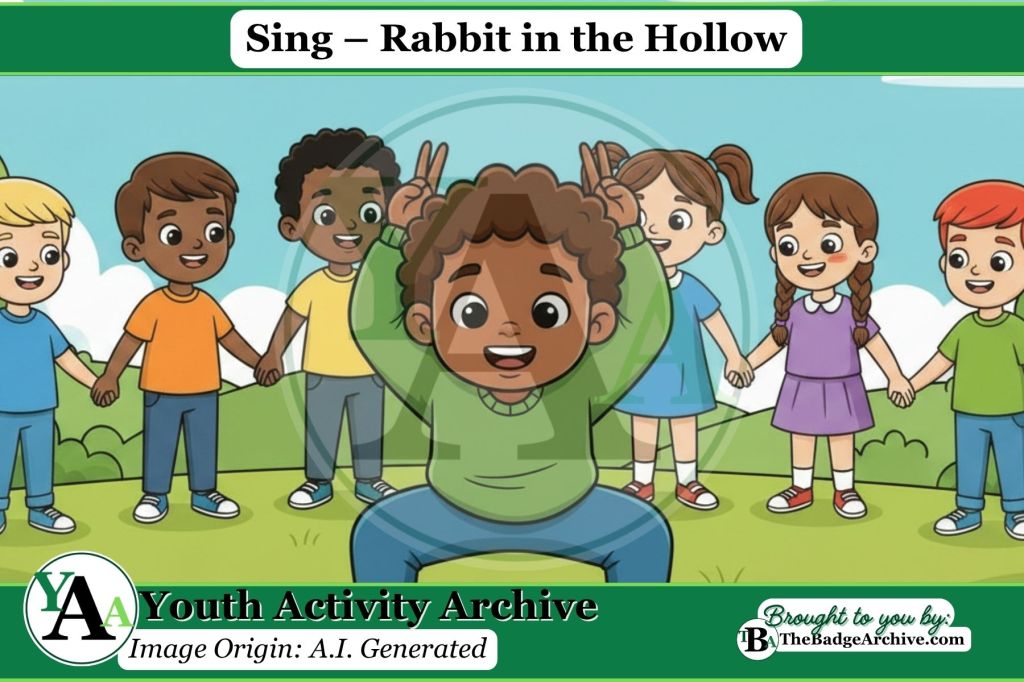
This song is paired with a movement game. Scouts form a circle. Two scouts are chosen. One is the rabbit and starts inside the circle. One is the hunter and waits outside the circle. Scouts march in place while singing each verse. At “run, run, run” the rabbit runs and can go in and out of the circle. The hunter is allowed to run in and out of the circle to tag the rabbit. The circle continues to sing and march in place. If the hunter tags the rabbit, that is the end of the round and no more singing is needed. If the rabbit is free when “hop, hop, hop” is sung, the rabbit must hop at each “hop” regardless of if the hunter is near or not. If the rabbit stays free when “hide, hide, hide” is sung, the rabbit wins and the circle marches to “hide” the rabbit from the hunter. The song starts again from the beginning and the game keeps going with new hunters and rabbits.
Recordings
- None available. See pg. 34 of The Brownie Book for the notes to sing.
Lyrics
Rabbit in the hollow sits and sleeps,
Hunter in the forest nearer creeps.
Little rabbit have a care,
Deep within the hollow there.
Quickly to your home you must run, run, run.
Rabbit in the hollow sits and sleeps,
Hunter in the forest nearer creeps.
Little rabbit have a care,
Deep within the hollow there.
Quickly to your home you must hop, hop, hop.
Rabbit in the hollow sits and sleeps,
Hunter in the forest nearer creeps.
Little rabbit have a care,
Deep within the hollow there.
History
Originally a German singing game titled “Häschen in der Grube” (Little Hare in the Pit), this song was composed by Friedrich Fröbel in 1840 for his first Kindergarten. While often confused with his later Mother-Play book, this game was published as a standalone “movement game” to teach nature observation. It was adapted from an 18th-century “Nixie” game and spread throughout Europe, becoming a Swedish favorite as “Haren i busken.” In 1907, Mari Hofer translated it for American youth, and it was officially included on page 34 of the first Girl Scout Brownie Book (1922) as a primary lesson in agility and group protection.
The song originated in Germany as “Häschen in der Grube” (Little Hare in the Pit). This song was composed by Friedrich Fröbel in 1840 for his first Kindergarten. Fröbel adapted it from an 18th-century “Nixie” game, replacing the stealing Nixie with a bunny. He used the game to teach young children about nature and social observation. It spread throughout Europe, becoming a Swedish favorite as “Haren i busken” (The Hare in the Bush).
In 1907, Mari R. Hofer translated and adapted the song for American schools in her book Popular Folk Games and Dances. She is the one who added the active chase element (the “run, run, run” and “hop, hop, hop” endings) to make it more physically engaging for large groups of children. The song was included in the very first Brownie Girl Scout manual, appearing on page 34 of The Brownie Book (1922).
–
For More Fun Ideas and Plans

Join the Girl Scout Daisy, Brownie, and Junior Leader Help Facebook Group
(Not an official GSUSA Group)

Join the Girl Scout Cadette, Senior, and Ambassador Leader Help Facebook Group
(Not an official GSUSA Group)

See other Recommended Facebook Groups for some Scouting Organizations
(No official Groups)
–
Click Here -> To see information References:
Disclaimer: The information published on Youth Activity Archive and The Badge Archive is built from the references listed below. These sources demonstrate that our content is grounded in facts and research, not opinion or speculation. Readers may consult them directly when looking for additional material.
- The Brownie Book: A Manual for Leaders of Junior Girl Scouts. United States of America, Girl Scouts, Inc., 1922. p. 34.
- Froebel, Friedrich. The Mother’s Songs, Games and Rhymes. Translated by Frances Lord and Emily Lord, William Rice, 1885.
- Hofer, Mari Ruef. Popular Folk Games and Dances. Chicago, A. Flanagan & Co., 1907.
- State Normal School of Colorado. A Course in History for Elementary Schools. Bulletin Series X. No. 10, Greeley, Colorado, Trustees of the State Normal School of Colorado, March 1911. p. 50.
- Watson, Bruce. “Friedrich Froebel Created Kindergarten and Designed the Froebel Gifts and Blocks.” Froebelweb.org, https://froebelweb.org/. Accessed 20 Apr. 2026.
- Find out how you can support The Badge Archive!
- Choose a different Movement Song.
- Return to the Singing Scouts page.