The national anthem of the United States, symbolizing resilience and triumph in adversity.
Lyrics by: Francis Scott Key
Music by: John Stafford Smith
Printable Sheet Music
Recordings
Lyrics
Oh say, can you see, by the dawn’s early light,
What so proudly we hailed at the twilight’s last gleaming,
Whose broad stripes and bright stars, through the perilous fight,
O’er the ramparts we watched, were so gallantly streaming?
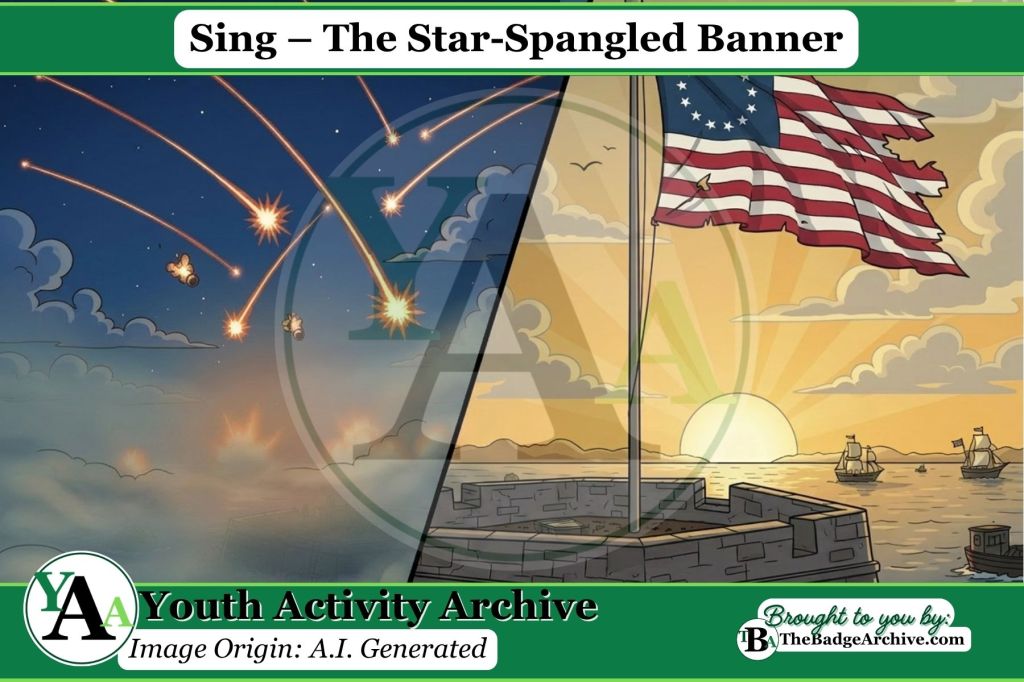
And the rockets’ red glare, the bombs bursting in air,
Gave proof thru the night that our flag was still there.
Oh say, does that star-spangled banner yet wave
O’er the land of the free and the home of the brave?
On the shore, dimly seen thru the mists of the deep,
Where the foe’s haughty host in dread silence reposes,
What is that which the breeze, o’er the towering steep,
As it fitfully blows, half conceals, half discloses?
Now it catches the gleam of the morning’s first beam,
In full glory reflected now shines on the stream;
’Tis the star-spangled banner! Oh, long may it wave
O’er the land of the free and the home of the brave!
Oh, thus be it ever, when free men shall stand
Between their loved homes and the war’s desolation!
Blest with vict’ry and peace, may the heav’n-rescued land
Praise the Pow’r that hath made and preserved us a nation!
Then conquer we must, when our cause it is just,
And this be our motto: “In God is our trust!”
And the star-spangled banner in triumph shall wave
O’er the land of the free and the home of the brave!
History
The words to “The Star-Spangled Banner” were written by Francis Scott Key (1779–1843), a lawyer and amateur poet. During the War of 1812, Key was aboard a British ship in Baltimore Harbor on a mission to secure the release of an American prisoner, Dr. William Beanes.
On the night of September 13, 1814, Key witnessed the intense British bombardment of Fort McHenry. Throughout the “perilous fight,” the smoke and darkness made it impossible to see if the fort had surrendered. When the “dawn’s early light” finally broke on September 14, Key saw the oversized American flag (the Garrison Flag) still waving defiantly over the ramparts. Inspired, he began jotting down the verses on the back of a letter he had in his pocket.
The melody was composed by John Stafford Smith (1750–1836), a British composer. Interestingly, the tune was not originally written for Key’s poem. It was created around 1775 as the official song for the Anacreontic Society, a gentlemen’s musical club in London, and was titled “To Anacreon in Heaven.” The tune was already popular in America and had been used for several other songs before Key’s brother-in-law suggested pairing it with the new poem, then titled “Defence of Fort M’Henry.”
–
For More Fun Ideas and Plans

Join the Girl Scout Daisy, Brownie, and Junior Leader Help Facebook Group
(Not an official GSUSA Group)

Join the Girl Scout Cadette, Senior, and Ambassador Leader Help Facebook Group
(Not an official GSUSA Group)

See other Recommended Facebook Groups for some Scouting Organizations
(No official Groups)
–
Click Here -> To see information References:
Disclaimer: The information published on Youth Activity Archive and The Badge Archive is built from the references listed below. These sources demonstrate that our content is grounded in facts and research, not opinion or speculation. Readers may consult them directly when looking for additional material.
- Allen, Erin. “First Drafts: “the Star-Spangled Banner”.” Library of Congress Blog, 19 Oct. 2012, https://blogs.loc.gov/loc/2012/10/first-drafts-the-star-spangled-banner/. Accessed 22 Apr. 2026.
- The Church of Jesus Christ of Latter-Day Saints. “The Star-Spangled Banner.” Churchofjesuschrist.org, 2026, http://www.churchofjesuschrist.org/study/manual/hymns/the-star-spangled-banner?lang=eng. Accessed 22 Apr. 2026.
- Veterans Affairs. “The Star-Spangled Banner: History, Lyrics, and More.” Va.gov, 4 Jan. 2024, https://www.va.gov/montana-health-care/programs/the-star-spangled-banner-history-lyrics-and-more/. Accessed 22 Apr. 2026.
- Find out how you can support The Badge Archive!
- Choose a different Patriotic Song.
- Return to the Singing Scouts page.