Paired with a movement game of mini tug of war.
Sung to the tune of The Mulberry Bush.
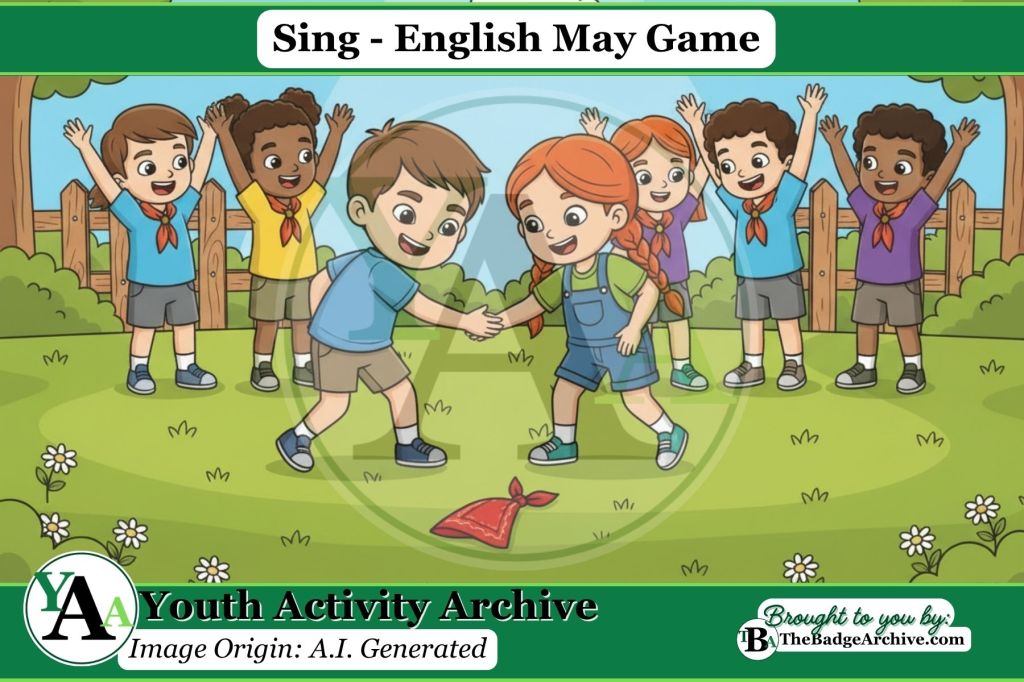
This song is paired with a movement game and requires a bandana. Sing verses back and forth, each row taking turns while marching in place or forward and back. At verse 6, a leader drops a bandana between a pair. That pair joins right hands and tries to gently pull each other across the line. The scout who gets pulled over joins the opposite side. The winner keeps the bandana and choses the next pair. Keep playing until everyone’s chosen. (Optional) End with a big tug of war between teams.
Recordings
- None available. See The Mulberry Bush for the tune.
See pg. 32 of The Brownie Book for the notes to sing.
Lyrics
Here we come gathering boughs in May,
Boughs in May, boughs in May;
Here we come gathering boughs in May,
This cold and frosty morning.
Whom will you have for your bough in May,
Boughs in May, boughs in May;
Whom will you have for your bough in May,
This cold and frosty morning.
We will have Mary for our bough in May,
Boughs in May, boughs in May;
We will have Mary for our bough in May,
This cold and frosty morning.
You may have Mary for your bough in May,
Boughs in May, boughs in May;
You may have Mary for your bough in May,
This cold and frosty morning.
Whom will you have to pull her away,
Pull her away, pull her away;
Whom will you have to pull her away,
This cold and frosty morning.
We will have Katie to pull her away,
Pull her away, pull her away;
We will have Katie to pull her away,
This cold and frosty morning.
History
This song was titled “Nuts in May” as a traditional English singing game with roots stretching back to the 17th century. While the modern lyrics mention “gathering boughs in May,” the original version likely referred to “knots” (bunches) of may-blossom. The game was traditionally played as a line game, where two rows of children advanced and retreated toward each other, mimicking a tug-of-war or a quest for spring greenery.
The song gained widespread popularity in the United States during the early 20th century as a tool for physical education and social bonding in youth groups. It was prominently featured in “The Brownie Book” (1922) (the original handbook for the youngest Girl Scouts) where it was introduced as a “May Game” to encourage teamwork and friendly competition.
–
For More Fun Ideas and Plans

Join the Girl Scout Daisy, Brownie, and Junior Leader Help Facebook Group
(Not an official GSUSA Group)

Join the Girl Scout Cadette, Senior, and Ambassador Leader Help Facebook Group
(Not an official GSUSA Group)

See other Recommended Facebook Groups for some Scouting Organizations
(No official Groups)
–
Click Here -> To see information References:
Disclaimer: The information published on Youth Activity Archive and The Badge Archive is built from the references listed below. These sources demonstrate that our content is grounded in facts and research, not opinion or speculation. Readers may consult them directly when looking for additional material.
- The Brownie Book: A Manual for Leaders of Junior Girl Scouts. United States of America, Girl Scouts, Inc., 1922. p. 32.
- “Game – Nuts in May.” Dúchas.ie, 2026, https://www.duchas.ie/en/cbes/4498746/4385897/4510178. Accessed 19 Apr. 2026.
- “Nursery Rhyme.” Wikisource.org, Wikimedia Foundation, Inc., 20 June 2024, en.wikisource.org/wiki/Nuts_in_May. Accessed 19 Apr. 2026.
- “NUTS in MAY.” VWML Archives: English Folk Dance and Song Society, 2026, https://archives.vwml.org/songs/RoudFS/S550624. Accessed 19 Apr. 2026.
- Find out how you can support The Badge Archive!
- Choose a different Movement Song.
- Return to the Singing Scouts page.