A well-known folk ballad often sung with humor and exaggerated emotions.
Recordings
Lyrics
Chorus:
Oh my darling, oh my darling,
Oh my darling, Clementine,
You are lost and gone forever.
Dreadful sorry, Clementine.
Sing each Verse followed by the Chorus
In a cavern, in a canyon,
Excavating for a mine,
Dwelt a miner, Forty-Niner,
And his daughter, Clementine.
Light she was, and like a fairy,
And her shoes were number nine
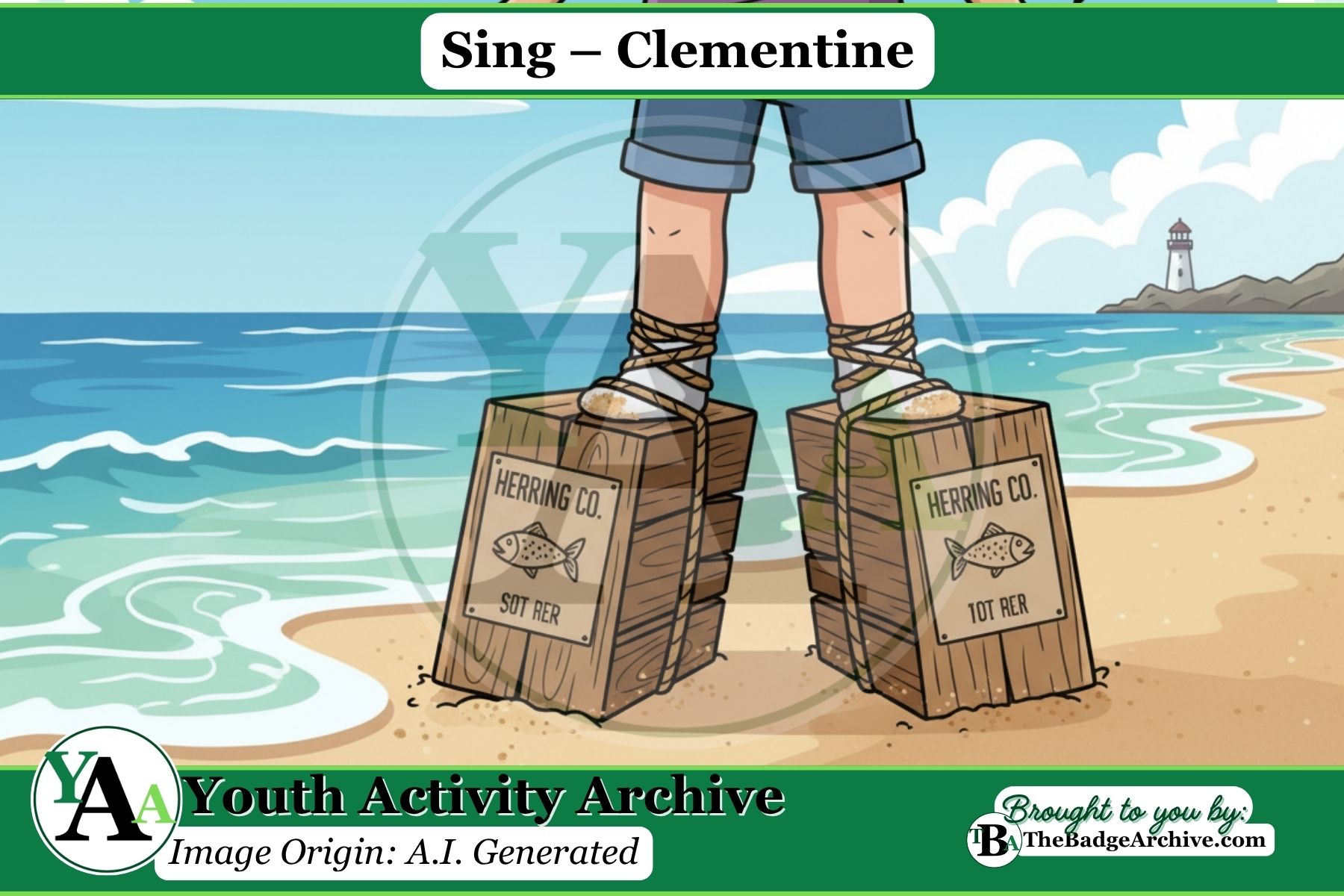
Herring boxes, without topses,
Sandals were for Clementine.
Drove she ducklings to the water
Ev’ry morning just at nine.
Hit her foot against a splinter,
Fell into the foaming brine.
Ruby lips above the water,
Blowing bubbles, soft and fine.
But, alas, I was no swimmer,
So I lost poor Clementine.
Variations:
A continuation of the story:
In a corner of the churchyard,
Where the myrtle boughs entwine,
Grow the roses and the posies,
Fertilized by Clementine.
Then the miner, Fourty-Niner,
Soon began to peak and pine.
Thought he otta, join his daughter.
Now he’s with poor Clementine.
In my dreams she still doth haunt me,
Robed in garments soaked with brine.
Though in life I used to hug her,
Now she’s dead, I’ll draw the line.
Now ye scouts, please head the warning
Of this tragic tale of mine:
Artificial respiration
Would have saved my Clementine.
How I missed her! How I missed her!
How I missed my Clementine!
But I kissed her little sister,
And forgot my Clementine.
History
Percy Montrose (1884) is credited with publishing the version in 1884 that established the standard lyrics and melody. Montrose intentionally wrote the song as a parody of the dramatic and sentimental “dying maiden” ballads popular during the Victorian era. By including absurd details (such as Clementine wearing “herring boxes without topses” for shoes) Montrose signaled that the song was a burlesque rather than a serious tragedy.
Barker Bradford (1885) published another version of the sheet music. While the content was nearly identical to the Montrose version, Bradford’s publication helped solidify the song’s commercial presence. The dual attribution exists because both men registered copyrights for their specific arrangements and lyrical tweaks within a year of each other, contributing to the song’s rapid spread across the United States.
H.S. Thompson (1863) published “Down by the River Liv’d a Maiden,” which Clementine is heavily derived from. Thompson’s original was a serious, non-satirical ballad. Montrose and Bradford adapted Thompson’s existing framework, changed the tone to satire, and updated the setting to the California Gold Rush to create the “Clementine” persona.
–
For More Fun Ideas and Plans

Join the Girl Scout Daisy, Brownie, and Junior Leader Help Facebook Group
(Not an official GSUSA Group)

Join the Girl Scout Cadette, Senior, and Ambassador Leader Help Facebook Group
(Not an official GSUSA Group)

See other Recommended Facebook Groups for some Scouting Organizations
(No official Groups)
–
Click Here -> To see information References:
Disclaimer: The information published on Youth Activity Archive and The Badge Archive is built from the references listed below. These sources demonstrate that our content is grounded in facts and research, not opinion or speculation. Readers may consult them directly when looking for additional material.
- “Clementine (Roud 9611).” Mainlynorfolk.info, 2025, https://mainlynorfolk.info/steeleye.span/songs/clementine.html. Accessed 19 Apr. 2026.
- “Oh My Darling, Clementine by Traditional.” Songfacts.com, Songfacts, 2026, https://www.songfacts.com/facts/traditional/oh-my-darling-clementine. Accessed 19 Apr. 2026.
- ““Oh My Darling, Clementine” – the Tragic Love Story behind a Western Ballad.” Tumbleweed Trails, 16 Feb. 2024, https://andrewflagstaff04.wordpress.com/2024/02/16/oh-my-darling-clementine-the-tragic-love-story-behind-a-western-ballad/. Accessed 19 Apr. 2026.
- The Morgan Library & Museum. “Oh, My Darling Clementine : Song and Chorus / by Percy Montrose.” Themorgan.org, 2026, https://www.themorgan.org/music-manuscripts-and-printed-music/140365. Accessed 19 Apr. 2026.
- Find out how you can support The Badge Archive!
- Choose a different Classic Song.
- Return to the Singing Scouts page.