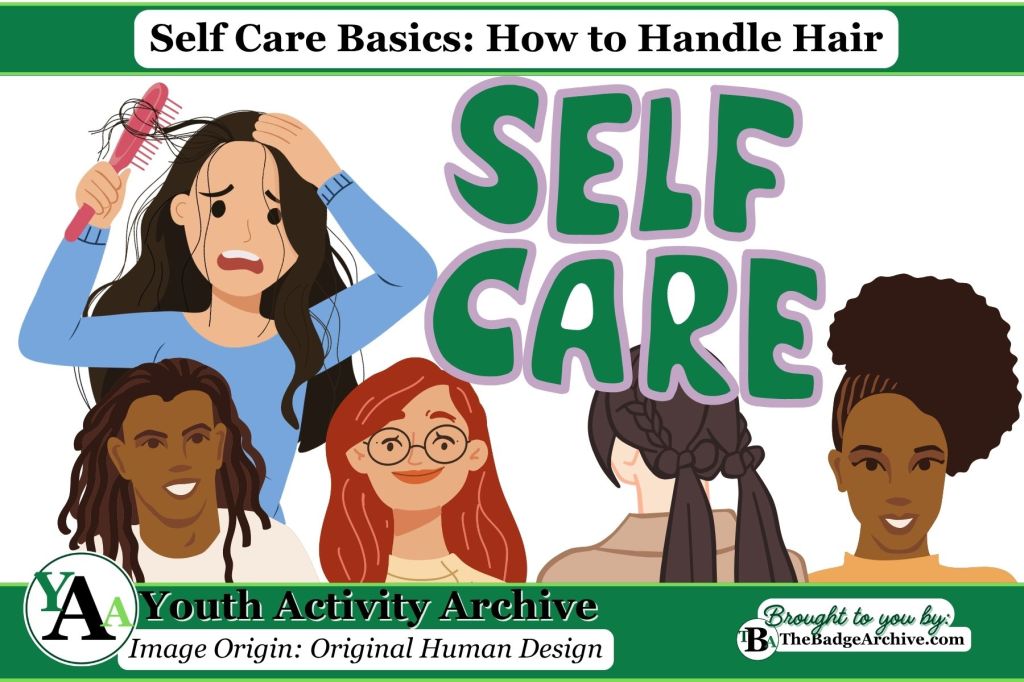
Activity Description: Basic hair care by exploring how different hair types (such as straight, curly, coily, or protective styles) require unique routines to stay neat and healthy.
Items Needed:
- Handheld mirrors or a large wall mirror
- Wide-tooth combs for curly or coily hair
- Standard hairbrushes or fine-tooth combs for straight or wavy hair
- Spray bottles with water or leave-in detangling mist
- Examples or pictures of protective sleep caps like satin bonnets or scarves
- (Optional) Hair ties, headbands, or clips
Instructions (Estimated Total Time: 20–30 min):
- Explore hair types. (5 min)
- Examine different hair textures in the mirror to understand that everyone has unique hair care needs. Explain that hair can be straight, wavy, curly, coily, or secured in protective styles like braids and locs.
- Emphasize that neat hair looks different for everyone and means keeping it clean, healthy, and out of the eyes.
- Practice correct neatness routines. (10–15 min).
- Guide those with straight or wavy hair to practice gentle brushing from the ends upward to remove tangles.
- Instruct those with curly or coily hair to use wide-tooth combs with a water mist, or use fingers to shape their hair instead of dry brushing.
- Help those with protective styles like braids or locs check for stray lint and practice smoothing the surface gently without disturbing the style.
- Review. (5–10 min)
- Review special tools and routines used to protect different hair textures during sleep or active play. Examples: Show a satin bonnet or scarf and explain how it keeps curls, coils, and braids safe and untangled at night. Show overnight curlers for those that dislike hot irons to create curls in straight hair.
- (Optional) Demonstrate how to use a simple headband or clip to keep stray hair out of the eyes during physical activities.
–
For More Fun Ideas and Plans

Join the Girl Scout Daisy, Brownie, and Junior Leader Help Facebook Group
(Not an official GSUSA Group)

Join the Girl Scout Cadette, Senior, and Ambassador Leader Help Facebook Group
(Not an official GSUSA Group)

See other Recommended Facebook Groups for some Scouting Organizations
(No official Groups)
–
Click Here -> To see information References:
Disclaimer: The information published on Youth Activity Archive and The Badge Archive is built from the references listed below. These sources demonstrate that our content is grounded in facts and research, not opinion or speculation. Readers may consult them directly when looking for additional material.
- Ford, Cindy, and Candace White Ciraco. Daisy Girl Scouts Leaders’ Guide. New York, NY, Girl Scouts of the U.S.A., 1983.
- Find out how you can support The Badge Archive!
- Choose a different 1983 Daisy Leader Guide Self Care activity.