Activity Description: Introduce basic cleaning skills through a step-by-step group demonstration where randomly assigned teams practice tasks on a shared Kaper Chart.
Items Needed:
- Kaper Chart or board listing 3–4 distinct chores
- Container for drawing names
- Slips of paper with names written on them
- Tools needed to do the chores on the Kaper Chart, such as:
- Child-sized brooms and dustpans
- Trash bags or waste baskets
- Storage bins for organizing supplies
- Small cleaning cloths
Before the Meeting Starts:
- Create the Kaper Chart. (5–10 min)
- Use a poster board, whiteboard, or a large piece of paper that can be easily seen by the entire group. Guide each team as they practice their assigned cleaning skills.
- Write 3 or 4 specific jobs clearly on the chart, leaving space next to each for team markers. For this activity, the following are used:
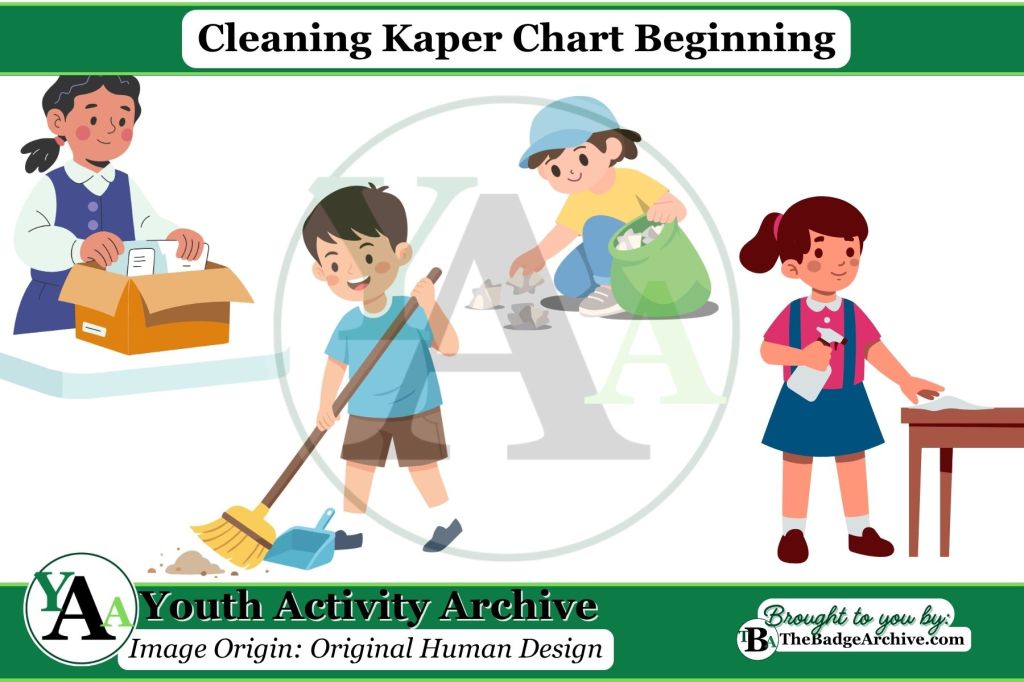
- Sweeping Team: Sweeps the floor and uses the dustpan.
- Organizing Team: Puts supplies, toys, and materials back into their proper bins.
- Trash Team: Collects trash from small bins and places bags by the exit.
- Table Team: Wipes down tables and clears surfaces.
- Instead of individual names, create movable markers for the small groups. (e.g., Team 1, Team 2, Team 3, Team 4 or Red Team, Blue Team, Green Team). Write these group names onto clothespins, magnets, or index cards with Velcro.
- Clip or stick the team identifiers next to the assigned tasks on the chart before the meeting begins. If used for future meetings, physically rotate the team markers down to the next task so each group automatically gets a turn at a different chore.
- Prepare the drawing container. (5–10 min)
- Write or print the names of all youth on slips of paper.
- Place these in the drawing container.
Instructions (Estimated Total Time: 30–40 min):
- Introduce the Kaper Chart. (2–5 min)
- Explain how small teams will work together on chores.
- Show how teams of two to three youth are assigned to each specific task instead of using individual names. Explain how they can collaborate to get the tasks done together.
- Assign the teams. (2–5 min)
- Randomly draw names from a container to form small teams and assign chores on the Kaper Chart. Each team gets two to three names to ensure a fair and random assignment.
- Assign teams to the Kaper Chart. (2–5 min)
- Remove the Team names from the Kaper Chart used to explain. Place them in the drawing container.
- Draw one team name at a time to be assigned to the Kaper Chart starting from the top and working towards the bottom.
- Explain that the assigned teams will help demonstrate each chore today while the other teams watch. Clarify that the entire group will move together through all the chores so everyone learns how to do them for the future.
- Sweep as a group. (5 min)
- Gather everyone at the first chore station to demonstrate and practice sweeping. Model how to use the broom and dustpan correctly.
- Focus on organizing supplies. (5 min)
- Demonstrate how to sort materials and place them back into the proper storage bins.
- Learn about trash collection. (5 min)
- Show how to safely gather small trash bins and place the bags near the exit.
- Demonstrate wiping down the tables. (5 min)
- Show how to use a damp cloth to wipe surfaces clean using smooth strokes.
- Celebrate and Review. (5 min)
- Gather the entire group to celebrate completing the Kaper Chart and review their new skills.
- Lead a round of applause or a simple cheer to celebrate their successful teamwork.
- Emphasize that they are all big enough to help out and take care of themselves.
–
For More Fun Ideas and Plans

Join the Girl Scout Daisy, Brownie, and Junior Leader Help Facebook Group
(Not an official GSUSA Group)

Join the Girl Scout Cadette, Senior, and Ambassador Leader Help Facebook Group
(Not an official GSUSA Group)

See other Recommended Facebook Groups for some Scouting Organizations
(No official Groups)
–
Click Here -> To see information References:
Disclaimer: The information published on Youth Activity Archive and The Badge Archive is built from the references listed below. These sources demonstrate that our content is grounded in facts and research, not opinion or speculation. Readers may consult them directly when looking for additional material.
- Ford, Cindy, and Candace White Ciraco. Daisy Girl Scouts Leaders’ Guide. New York, NY, Girl Scouts of the U.S.A., 1983.
- Find out how you can support The Badge Archive!
- Choose a different 1983 Daisy Leader Guide Self Care activity.