Activity Description: Learn about the African Savanna Elephant through simple movement, size comparisons, and an exploration of its savanna habitat and family behaviors.
Items Needed:
- Picture of an African Savanna Elephant
- (Optional) Picture of a savanna or scrub forest habitat
- (Optional) A toy school bus or a heavy brick to visually compare weights
- (Optional) List of African Savanna Elephant Facts
Instructions (Estimated Total Time: 10–15 min):
- Meet the elephant. (2–3 min)
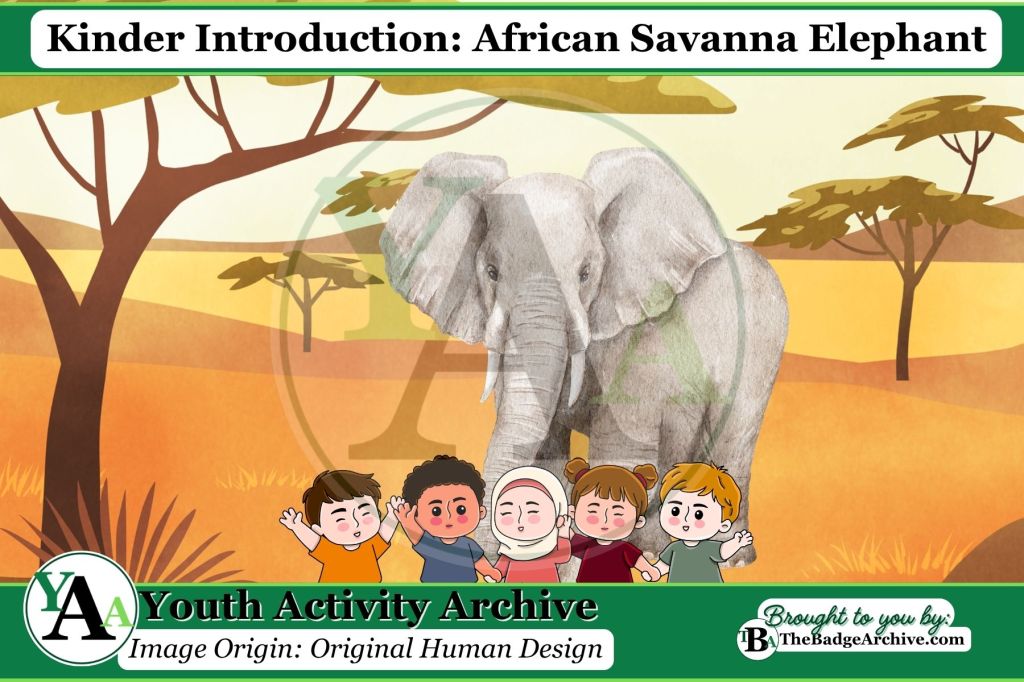
- African Savanna Elephants, also called the African Bush Elephant, are mammals known for being the largest land animals in the world.
- An adult male elephant stands 11 feet tall at the shoulder and can weigh between 12,000 and 14,000 pounds—which is heavier than a school bus!
- Do you see their wrinkled, saggy skin, long trunk, and huge ears? Their ears can grow over 6 feet long from top to bottom and are shaped like the continent of Africa!
- Stand tall, stretch your arms out wide like giant 6-foot elephant ears, and imagine trying to stomp while being as heavy as a school bus.
- Try elephant movements. (3–4 min)
- Elephants are unique because they have four knees that all bend in the same direction, and they walk gracefully and quietly on their toes because they have large cushion pads underneath their feet.
- When different elephant families meet up, they enjoy family reunions where they run toward each other, flap their giant ears, trumpet loudly, and entwine their trunks to say hello!
- Youth can march quietly on their tiptoes, gently flap their arms like ears, and pretend to gracefully entwine trunks with a neighbor to say hello joyfully.
- Explore the African Savanna Elephant’s home. (2–3 min)
- To find an African Savanna Elephant, you must explore hot, flat grasslands, open savannas, and dry scrub forests in countries like Kenya, South Africa, and Zimbabwe.
- When the sun gets blazing hot, elephants stay cool by standing in the shade, flapping their ears to cool their blood, rolling in mud, or throwing a trunkful of soil to coat their backs with dust.
- Pretend to step out of the hot sun and use your trunk to spray imaginary mud or dust all over your back to stay cool.
- Discover how elephant’s find food. (2–3 min)
- Elephants are herbivores that spend most of their day eating over 200 to 300 pounds of plants, including grass, leaves, fruits, and tree bark.
- They use two flexible finger-like projections at the very tip of their long trunks to precisely pick up a single leaf or a blade of grass. They also use their heavy tusks to dig for water in dry riverbeds or rip loose tree bark.
- Pretend your arm is a long trunk with 40,000 muscles. Use your fingers at the tip to precisely pick up a single blade of grass, suck up water, and squirt it down your throat!
- Reflect together. (1–2 min)
- Elephants live in related family herds led by an old, wise female leader called a matriarch, and they care deeply about one another.
- They talk to each other across long distances using deep vocal rumbles that travel through the ground, which humans cannot hear but other elephants can feel through their feet.
- If you could send a secret rumble message through the ground to a family member or friend to show you care about them, what would your message say?
- (Optional Activity): Look at the unique lines on the palms of your hands. Just like human fingerprints, the deep creases on an elephant’s legs are completely unique to every individual elephant!
–
For More Fun Ideas and Plans

Join the Girl Scout Daisy, Brownie, and Junior Leader Help Facebook Group
(Not an official GSUSA Group)

Join the Girl Scout Cadette, Senior, and Ambassador Leader Help Facebook Group
(Not an official GSUSA Group)

See other Recommended Facebook Groups for some Scouting Organizations
(No official Groups)
–
Click Here -> To see information References:
Disclaimer: The information published on The Badge Archive is built from the references listed below. These sources demonstrate that our content is grounded in facts and research, not opinion or speculation. Readers may consult them directly when looking for additional material.
- Hall, Kirsten. African Elephant : The World’s Biggest Land Mammal. New York, Bearport Pub, 2007.
- Haugen, Brenda. Endangered and Threatened Animals: African Elephants. North Mankato, MN, Capstone, 2013.
- Hirsch, Rebecca E. Comparing Animal Traits: African Elephants: Massive Tusked Mammals. Minneapolis, MN, Lerner Publishing Group Inc. 2015.
- Redmond, Ian. Elephant. New York, NY, Alfred A. Knopf, 1993.
- Smith, Roland. African Elephants. Minneapolis, MN, Lerner Publications Co., 1995.
- Takahama, Valerie, et al. How to Guide Girl Scout Daisies through 5 Flowers, 4 Stories, 3 Cheers for Animals. Girl Scouts of the U.S.A., 2010, p. 97.
- Taylor, Dave. The Elephant and the Scrub Forest. New York, NY, Crabtree Publishing Co., 1990.
–
- Find out how you can support The Badge Archive!
- Choose a different Animal Kinder Introduction activity.