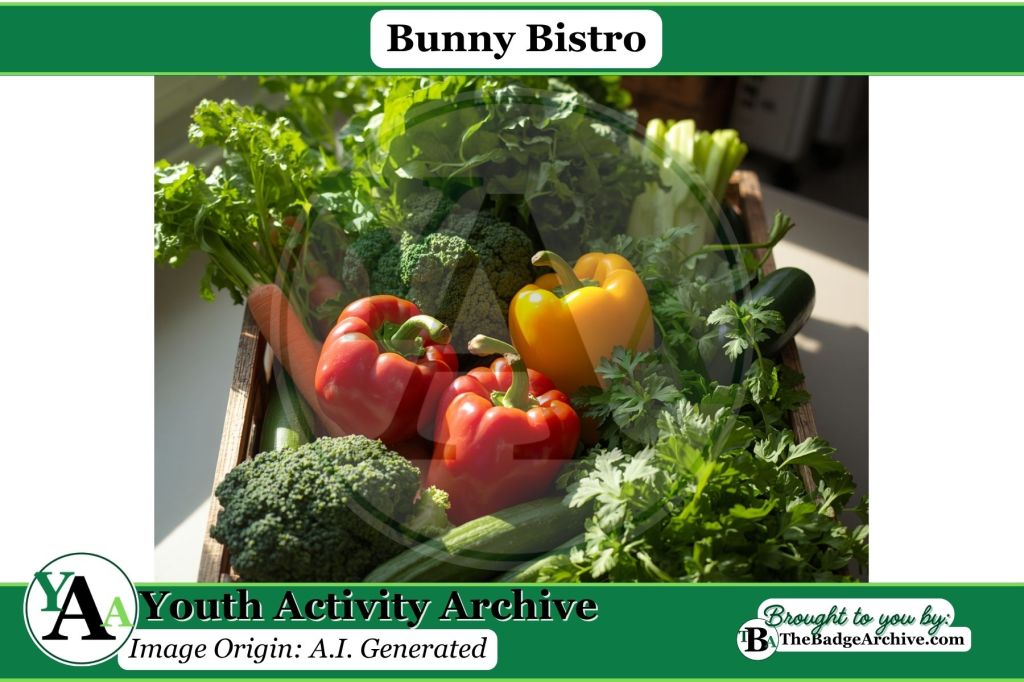
Activity Description: Taste test vegetables that humans and rabbits can both enjoy while learning about rabbit diets.
Items Needed:
- A carrot with the green leaf top
- Washed vegetables: carrots, romaine lettuce, bell peppers, cucumbers, celery, broccoli, kale, parsley, cilantro, mint
- See a full list of possible veggies on Rabbit.org
- Small bowls or trays for each vegetable
- Hummus, low‑fat yogurt, ranch, dill, or other vegetable dips
- Cutting board and knife for adult use only
- (Optional) Bags or boxes for sensory sorting
- (Optional) Hand wipes or a handwashing station
Before the Meeting Starts:
- Prepare the vegetables. (3–4 min)
- Confirm all youth food allergies before beginning.
- Wash all vegetables thoroughly.
- Cut hard vegetables into thin slivers or small bite‑sized pieces.
- Keep leaf lettuce in large leaves ready for youth to tear into pieces.
- Have snap peas whole, ready for youth to snap themselves.
- Place each vegetable in a separate bowl or tray.
Instructions (Estimated Total Time: 20–25 min):
- The “Green Topper” example. (3–4 min)
- Show the small, washed carrot with the green leaf top.
- Rabbits eat many of the same vegetables humans do, but often prefer different parts of the plant. Explain that humans usually eat the orange root, while rabbits should eat the leafy greens to stay healthy and only eat small amounts of the root as a treat.
- Youth help set out the Bistro. (5–7 min)
- Set out a “Bistro Menu” of shared vegetables.
- Have youth help “prep” vegetables by snapping green beans or tearing lettuce into small pieces.
- Go over the dip options for youth.
- Try the Bistro. (5–7 min)
- Have youth select at least three different veggies and two different dips. They are allowed more, but must try at least that minimum amount.
- Clean up and review. (7–10 min)
- Dispose of scraps and wipe down surfaces.
- Review rabbit food care:
- Veggies are usually only 10% of a rabbit’s diet. Hay is 80% of their diet. Veggies are a small portion and sometimes a treat.
- Baby rabbits cannot have veggies until after 12 weeks of being born.
- Not all rabbits tolerate greens.
- Wet veggies help rabbits get more water, which helps them stay healthy. But veggies with too high water content isn’t good. Nor are veggies with high sugar, like the orange part of the carrot.
–
For More Fun Ideas and Plans

Join the Girl Scout Daisy, Brownie, and Junior Leader Help Facebook Group
(Not an official GSUSA Group)

Join the Girl Scout Cadette, Senior, and Ambassador Leader Help Facebook Group
(Not an official GSUSA Group)

See other Recommended Facebook Groups for some Scouting Organizations
(No official Groups)
–
Click Here -> To see information References:
Disclaimer: The information published on Youth Activity Archive and The Badge Archive is built from the references listed below. These sources demonstrate that our content is grounded in facts and research, not opinion or speculation. Readers may consult them directly when looking for additional material.
- Parsons, Paige K, and Creative Commons Remixed. “Best Vegetables for Rabbits: A Healthy Diet Guide.” Rabbit.org, https://rabbit.org/care/fruits-vegetables/. Accessed 17 Apr. 2026.
- Takahama, Valerie, et al. How to Guide Girl Scout Daisies through 5 Flowers, 4 Stories, 3 Cheers for Animals. Girl Scouts of the U.S.A., 2010. p. 40.
- Find out how you can support The Badge Archive!