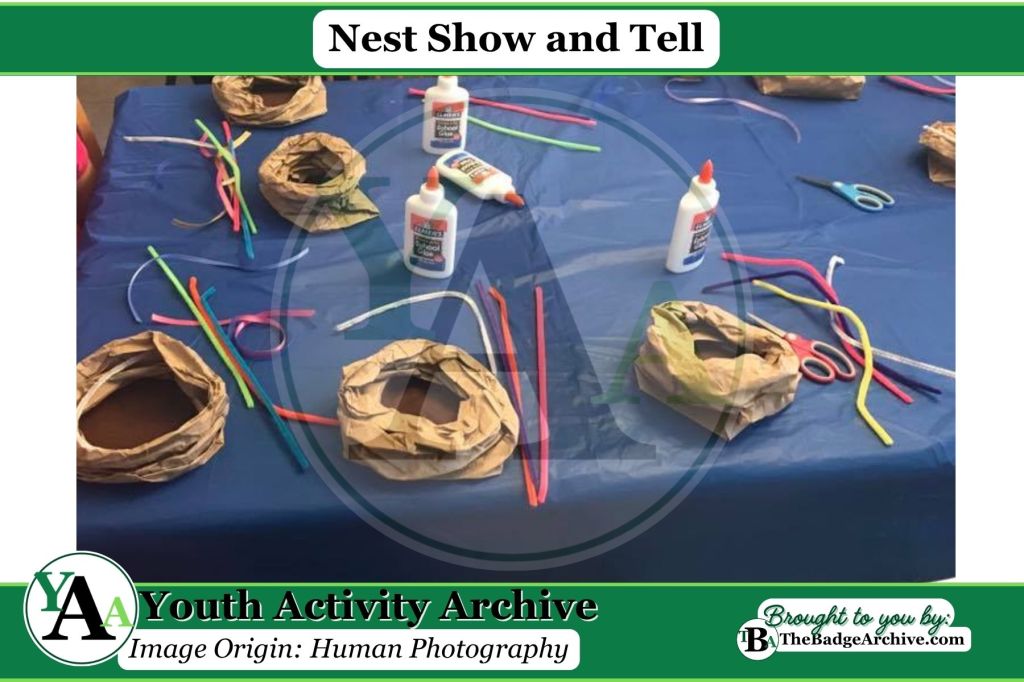
Activity Description: Two Meeting Activity: First, they create personal nests that Youth will decorate and use to hold items that represent who they are. Next, they choose three small items that fit inside the nest to show something important about who they are, what they like, or their family.
Meeting One Items Needed:
- Brown Paper Bags
- Art and decorating materials such as fabric, pipe cleaners, cotton, ribbon, and/or colored paper strips
- Glue
- TBA Early Self Care
- (Optional) Coloring tools
- (Optional) Hand wipes or a handwashing station
Meeting Two Items Needed:
- Paper Bag Nests from Meeting 1
- Three small items brought from home that fit inside each nest
- (Optional) Timer
Before Meeting One Starts:
- Prep The Early Self Care Cards. (3–4 min)
- Print a copy for each youth. Cut them so each youth has a set of four cards. Fold the cards in half and then half again, so they will fit in a Paper Bag Nest.
Meeting One Instructions (Estimated Total Time: 30–40 min):
- Build the nests. (3–4 min)
- Explain we are making nests, like birds do.
- “Birds build nests to keep their eggs and babies safe. Every bird makes a different kind of nest. Some nests are tiny, like a hummingbird’s. A coin can cover it! Some are huge, like an eagle’s. They weigh as much as a hippo! Birds use whatever they can find: leaves, grass, string, ribbon, and even little pieces of paper. Learning about nests helps us understand how birds live and how we can help protect their homes. We are making our own nests today so we can think about what keeps us safe, cared for, and supported, just like a nest does for a bird.”
- Take the paper bag and crumple the edges down so the bottom remains flat and all the edges are crumpled to form a nest shape.
- Explain we are making nests, like birds do.
- Decorate the nests. (15–20 min)
- Have youth use the art materials to glue different pieces to decorate their Paper Bag Nests.
- Encourage adding colors, textures, or patterns that feel special to them.
- Add Early Self Care Cards. (3–4 min)
- When they are done decorating their nest, give them each a set of self care cards to place in their nests to take home.
- (Optional) Provide coloring tools for them to color drawings for those who finish their nests early.
- Go over Self Care. (5–10 min)
- These cards show different ways youth can take care of themselves. Some youth can get their own clothes ready, wash their hands, brush their teeth, or pour their own breakfast. These are all ways to help their bodies stay healthy and strong.
- Ask youth “What are other things you can do by yourself to take care of yourself or help at home?” Keep the discussion short and positive, focusing on independence and confidence. Answers could be:
- Brush their own hair
- Put toys away
- Sweep a small area
- Help unload the dishwasher
- Fill a water bottle
- Make their bed
- Put dirty clothes in the hamper
- Help set the table
- Explain the Nests. (3–4 min)
- Explain that the self‑care cards can be taken home and kept. They can color them if they want. But the nests need to be kept save to bring back next week.
- Give them the challenge to choose three small items from home that can fit inside their nest. “Pick things that are special to you, but not anything expensive or something that might get lost. Choose items that help show who you are, what you like, or something important about your family. Next meeting you will surprise us by showing what you picked in a show‑and‑tell. If you forget your items, that’s okay. You will still get to tell us about yourself. This is just your chance to show us some fun things.”
- (Optional) Leaders can keep the nests until the nest meeting and the youth need to only bring items they think will fit inside them. Have youth place the items they brought from home inside their nest at the start of the next meeting.
- Notify Families
- Ensure each parent is handed the nests and told to store them safely for the next meeting. Provide them instructions on what the youth need to add to their nests.
Meeting Two Instructions (Estimated Total Time: 20–30 min):
- Verify the youth all brought items. (3–4 min)
- Check to make sure all nests have three small items in them that are appropriate to share. Those who forgot, help come up with three things they can say to share even without items.
- Share the items. (15–25 min)
- Invite youth to show their nest and explain why they chose each item.
- Work with the youth to keep explanations short and simple. Try and keep each youth to just 2 minutes of time.
- (Optional) Use a timer to help Youth wrap up quickly when time is up.
–
For More Fun Ideas and Plans

Join the Girl Scout Daisy, Brownie, and Junior Leader Help Facebook Group
(Not an official GSUSA Group)

Join the Girl Scout Cadette, Senior, and Ambassador Leader Help Facebook Group
(Not an official GSUSA Group)

See other Recommended Facebook Groups for some Scouting Organizations
(No official Groups)
–
Click Here -> To see information References:
Disclaimer: The information published on Youth Activity Archive and The Badge Archive is built from the references listed below. These sources demonstrate that our content is grounded in facts and research, not opinion or speculation. Readers may consult them directly when looking for additional material.
- Carpenter, Alice, et al. 5 Flowers, 4 Stories, 3 Cheers for Animals. Girl Scouts of the U.S.A., 2010. pp. 14–15.
- Girl Scouts of the U.S.A. “Meeting : 5 Flowers, 4 Stories, 3 Cheers for Animals! Pt. 2.” My.girlscouts.org, Girl Scouts of the U.S.A., https://my.girlscouts.org/content/girlscouts-vtk/en/vtk.html. Accessed 23 Jan. 2026.
- Takahama, Valerie, et al. How to Guide Girl Scout Daisies through 5 Flowers, 4 Stories, 3 Cheers for Animals. Girl Scouts of the U.S.A., 2010. p. 41.
- Find out how you can support The Badge Archive!
- Choose a different Early Self Care activity.