The week after Taffy and her Daddy, Tegumai, made their picture-letter mistake, they went back to the river to fish. Taffy’s Mummy wanted her to stay home to help dry animal skins on the drying-poles, but Taffy slipped away early to be with her Daddy.
While Tegumai scratched marks on birch bark with a shark’s tooth, Taffy had a new idea. She wanted to make a “secret surprise” using noises.
“Daddy, make a noise,” Taffy said.
“Ah!” said Tegumai.
“You look just like a carp-fish with its mouth open,” Taffy giggled. “I will draw a carp’s mouth to mean the Ah-sound.”
She scratched a wide-open mouth on the bark. Tegumai added a little line across it. That was the fish’s feeler, to show it was a carp and not a trout. That became the first mark.
“Now make another noise,” said Taffy.
“Ya!” said Tegumai.
“That is the Ah-sound at the end, but the front is a new noise,” Taffy said. “Let’s draw the carp’s tail for the Y-sound.”
Next, they made a mark for the O-sound. “That’s easy,” Taffy said. “When you say ‘Oh,’ your mouth looks like a round egg or a stone.” So, they drew a circle.
Then came the S-sound. “That is the noise a snake makes when it doesn’t want to be bothered,” Taffy said. She drew a wiggly snake.
Tegumai realized they could join these “sound-marks” to send messages.
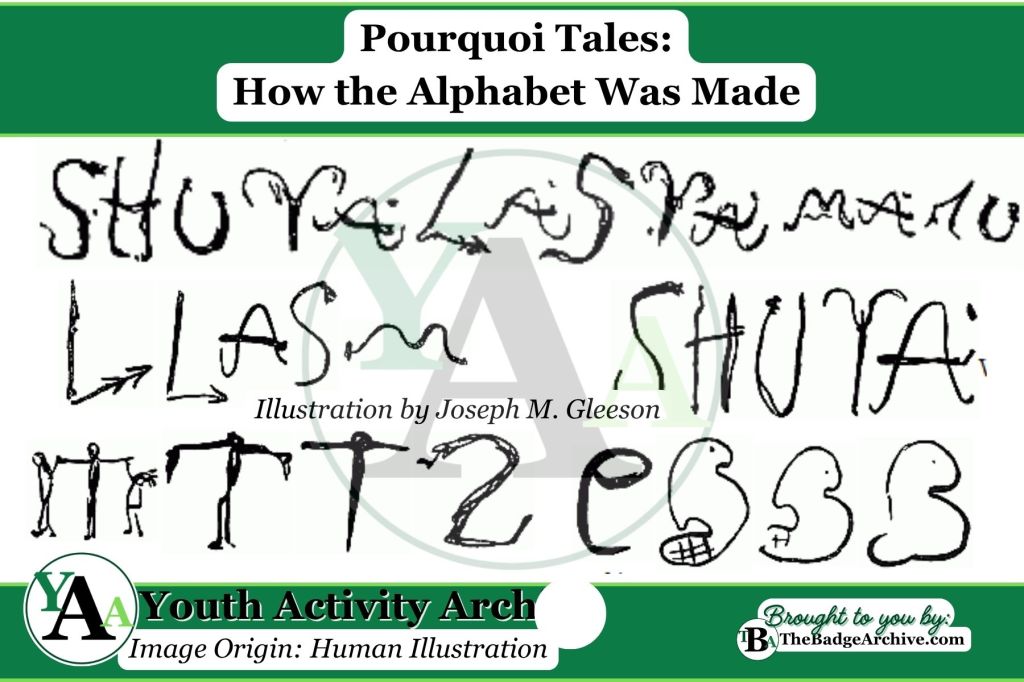
He drew the carp-tail (Y) and the egg (O). In their language, Yo meant “bad water.” If Taffy saw that mark by a pool, she would know not to drink it. Ya mean “good water”. They could tell someone if water was good to drink without even being there!
Tegumai drew the snake (S) and the egg (O). So meant “dinner is ready.” “If I draw these marks in the smoke on the cave wall,” Tegumai said, “I can tell you things even when I am not there!”
Taffy didn’t like that. Sho meant she would need to hang the animal skins to dry. If she went home thinking dinner was read only to hang things up, she would be mad.
Tegumai agreed. Even mother would be mad at that. Taffy drew the hanging poles between the S-sound and O-sound. Now it clearly showed Sho.
Shi meant “spear.” Tegumai drew the snake (S) and the hanging poles (H), then added a straight line for a spear (I).
“Now,” said Tegumai, his eyes shining, “let’s try a hard one. Shu means sky.”
Taffy drew the snake and the drying poles. Then she stopped. “How do we draw the end of the noise? Shu-shu-u-u-u?”
“It sounds like the round egg-noise, but thin,” Tegumai said. “Let’s draw a round egg with a little hole at the bottom so the noise can run out thin.” He drew a circle that didn’t quite close (U).
He scratched a long string of marks on a new piece of bark: SHU-YA.
“Try to read that, Taffy,” he said.
Taffy looked at the marks. “Snake… poles… thin egg… carp-tail… carp-mouth. Shu-ya! Sky-water!”
Just then, a tiny, wet PLOP hit Taffy’s hand. She looked up. The sky had turned grey.
“Daddy! It’s raining!” Taffy danced in a circle. “You told me it was raining without saying a single word! If you drew that on the wall while I was asleep, I would know to grab my beaver-skin hood before I went outside!”
Tegumai laughed and danced too. “More than that, Taffy! Suppose I wanted to tell you that the rain is ending and you should come to the river? We would say: Shu-ya-las, ya maru.”
Taffy stopped dancing. “That is a lot of new sounds. How can we draw las?”
Tegumai waved his shark-tooth and frowned. “That is a teaser. La-la-la! How do we draw a La?”
Taffy leaned against the cave wall and gave a big yawn. “Daddy, las means breaking or finishing, doesn’t it?”
“So it does,” said Tegumai. “Yo-las means the water is finished. And shi-las means…”
“Your spear is broken!” Taffy finished. She felt a little silly thinking about her old picture-letter. “If I had only thought of that before! I could have drawn your spear broken, like this!”
She reached up to the smoky wall and drew a long line for the spear handle and a sharp, splintered line pointing out where it had snapped.
“The very thing!” Tegumai cried. “That is La all over! It doesn’t look like the carp-mouth or the snake. It is perfect.”
He drew it on his bark. There was one long line down, and one short line across (L).
“Now for maru,” said Tegumai. “We need a Mum-mum-mum sound. When you say Mum, your mouth shuts tight, doesn’t it?”
“Yes,” Taffy said, pressing her lips together.
“Then we will draw a shut mouth!” Tegumai drew a simple curvy line, like lips. That became the M-sound.
“But what about the rrrrr sound at the end of maru?” Taffy asked. “It sounds all rough and edgy, Daddy. Like your shark-tooth saw when you are cutting wood for the canoe.”
“Rough and edgy?” Tegumai asked. He drew a jagged, pointy line like the tooth of a saw. “Like this?”
“Exactly!” said Taffy. “But three points are too many.” Two was too many as well. They ended up with just one jagged point (R).
Tegumai put all the marks together in a long string. “Look, Taffy! Shu-ya-las ya-maru. The rain is over, come to the river!”
The rain started to fall harder, so they hurried back to the cave. All evening, Tegumai and Taffy sat by the fire. They used bits of charcoal to draw Ya’s and Yo’s and Shu’s in the smoke on the dark cave walls. They giggled and whispered until Teshumai sighed.
“Really, Tegumai,” she said, “you are worse than Taffy! What are you two doing?”
“It’s a secret surprise, Mummy!” Taffy cried. “Please don’t ask, or I’ll have to tell you!”
Her mother shook her head and went back to her sewing. They were so excited they spent the rest of the night drawing in the smoke. Even when Mummy told them it was time to sleep because the day was las (finished), they kept dreaming of all the new sounds they would draw tomorrow.
The next morning, Taffy woke up and looked at the big stone water-tank outside the cave. Chalked on the side were two marks: YA-LAS.
“Oh, bother!” Taffy stomped her foot. “I know what that says! Ya is water and Las means gone. Daddy has told me the water is finished!”
She had to walk all the way to the spring with her heavy bark buckets to refill the tank before she could go find her Daddy. “Maybe this writing wasn’t such a good idea,” she grumbled. “It just gives me more chores!”
But when she was finished, she realized how clever it was. Her Daddy was miles away at the river, but he had still talked to her! She ran down to the river to find him.
They spent the whole day making marks for every sound they knew. At first, the pictures were very detailed, but they soon learned to draw them faster and simpler:
For the T-sound, they started by drawing Taffy, Tegumai, and Teshumai holding hands. Three people were too many, and one person was really hard. They ended with a stick with two arms, making a simple “T.”
The B-sound started like one of Taffy’s beavers. But after drawing it over and over it was just a line with bumps.
For the N-sound, they drew a Nose because “N” is a “nosy” sound.
The W-sound was a curvy line for the Wagai River.
It took a long time, but they had a whole list of marks. They didn’t have to draw big, confusing pictures anymore. They had the very first Alphabet.
The Head Chief was amazed. “One day,” he said, “everyone will use these marks. We will be able to read and write exactly what we mean, and no one will ever get a ‘picture-letter’ wrong again.”
And ever since that day, whenever you see a letter or read a book, you can thank Taffy and her Daddy for their secret surprise on the smoky walls of the Cave.
About the Original Story
Original Title: “How the Alphabet Was Made”
From the Book: Just So Stories (1912)
Author: Rudyard Kipling
Type: This story is a Pourquoi Tale, a traditional legend or foundational story focused on explaining the origins of natural phenomena, animal physical traits, or cultural customs. These narratives serve as ancestral records and cultural adaptations that answer “how” or “why” a specific part of the natural world became the way it is today. Pourquoi is the French word for “why”.
History: This story follows the invention of the phonetic alphabet. Kipling used the characters of Taffy and Tegumai to show how complex drawings (pictograms) naturally evolve into simple, easy-to-draw letters (phonemes). This version adds the “Ya-las” and “Shu-ya” scenes to show children that writing is a tool for sharing information across time and distance.
–
For More Fun Ideas and Plans

Join the Girl Scout Daisy, Brownie, and Junior Leader Help Facebook Group
(Not an official GSUSA Group)

Join the Girl Scout Cadette, Senior, and Ambassador Leader Help Facebook Group
(Not an official GSUSA Group)

See other Recommended Facebook Groups for some Scouting Organizations
(No official Groups)
–
Click Here -> To see information References:
Disclaimer: The information published on Youth Activity Archive and The Badge Archive is built from the references listed below. These sources demonstrate that our content is grounded in facts and research, not opinion or speculation. Readers may consult them directly when looking for additional material.
- Kipling, Rudyard. Just so Stories. Doubleday Page & Company, 1912.
- Found on Gutenberg Library, 17 April 2026: https://www.gutenberg.org/ebooks/32488
- Find out how you can support The Badge Archive!
- See other Pourquoi Tales.