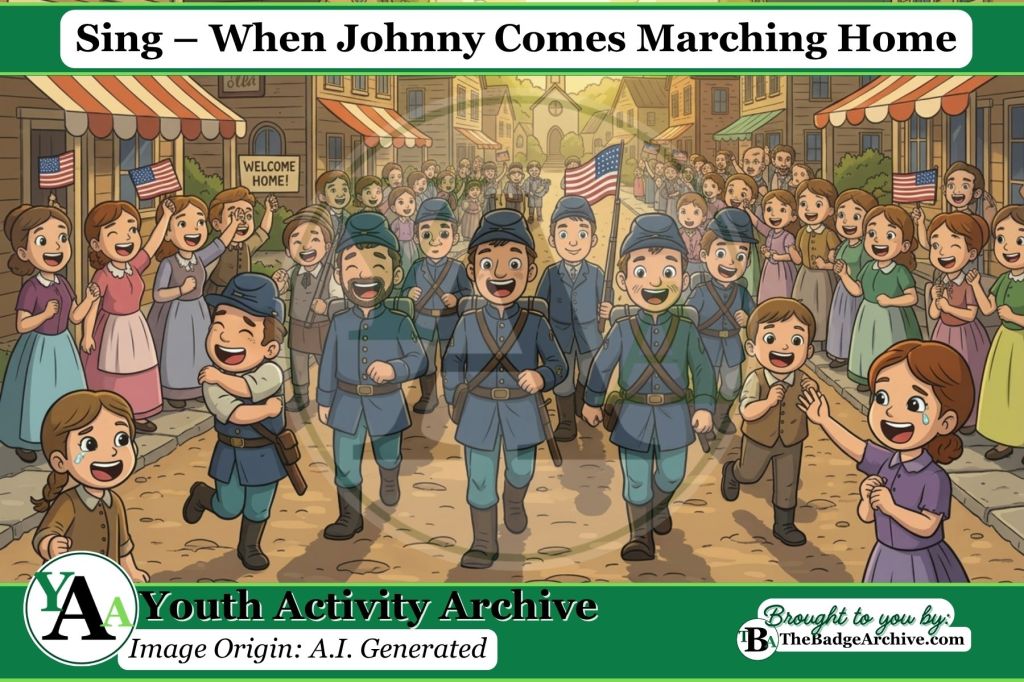
A spirited Civil War-era song expressing the hopeful anticipation of a soldier returning home from war to a hero’s welcome.
Lyrics and Music by: Louis Lambert (pseudonym for Patrick S. Gilmore)
Recordings
Lyrics
When Johnny comes marching home again,
Hurrah, hurrah!
We’ll give him a hearty welcome then,
Hurrah, hurrah!
The men will cheer, the boys will shout,
The ladies, they will all turn out,
And we’ll all feel gay when Johnny comes marching home.
The old church bell will peal with joy,
Hurrah, hurrah!
To welcome home our darling boy,
Hurrah, hurrah!
The village lads and lassies say,
With roses they will strew the way,
And we’ll all feel gay when Johnny comes marching home.
Get ready for the Jubilee,
Hurrah, hurrah!
We’ll give the hero three times three,
Hurrah, hurrah!
The laurel wreath is ready now
To place upon his loyal brow,
And we’ll all feel gay when Johnny comes marching home.
Let love and friendship on that day,
Hurrah, hurrah!
Their choicest treasures then display,
Hurrah, hurrah!
And let each one perform some part,
To fill with joy the warrior’s heart,
And we’ll all feel gay when Johnny comes marching home.
When Johnny comes marching home again,
Hurrah, hurrah!
We’ll give him a hearty welcome then,
Hurrah, hurrah!
The men will cheer, the boys will shout,
The ladies, they will all turn out,
And we’ll all feel gay when Johnny comes marching home.
History
“When Johnny Comes Marching Home” was written by Patrick Sarsfield Gilmore, an Irish immigrant to Boston who is often called the “Father of the American Band.” In September 1861, Gilmore and his band enlisted in the Union Army, attached to the 24th Massachusetts Infantry. They served as musicians and stretcher-bearers during major battles including Antietam and Gettysburg. Gilmore claimed to have composed the song in 1863 while he was posted to occupied New Orleans and ordered to reorganize the state military bands.
The song was first published in 1863 by Henry Tolman and Company of Boston under the pseudonym Louis Lambert, though the title page noted it was “as introduced by Gilmore’s Band.” It bore a formal dedication “To the Army and Navy of the Union.” While Gilmore claimed the melody was adapted from an African-American spiritual, music historians note its remarkable similarity to the Irish song “Johnny, I Hardly Knew Ye,” a protest song concerning British conscription.
–
For More Fun Ideas and Plans

Join the Girl Scout Daisy, Brownie, and Junior Leader Help Facebook Group
(Not an official GSUSA Group)

Join the Girl Scout Cadette, Senior, and Ambassador Leader Help Facebook Group
(Not an official GSUSA Group)

See other Recommended Facebook Groups for some Scouting Organizations
(No official Groups)
–
Click Here -> To see information References:
Disclaimer: The information published on Youth Activity Archive and The Badge Archive is built from the references listed below. These sources demonstrate that our content is grounded in facts and research, not opinion or speculation. Readers may consult them directly when looking for additional material.
- Duke University. “Sheet Music Lyrics When Johnny Comes Marching Home.” Duke.edu, 2024, https://library.duke.edu/rubenstein/scriptorium/sheetmusic/lyrics/Lambert__When_Johnny_comes_marching_home.html. Accessed 22 Apr. 2026.
- The Library of Congress. “When Johnny Comes Marching Home Again.” Loc.gov, 2015, https://www.loc.gov/collections/patriotic-melodies/articles-and-essays/when-johnny-comes-marching-home-again/. Accessed 22 Apr. 2026.
- “When Johnny Comes Marching Home: Song Lyrics and Sound Clip.” Songs for Teaching, https://www.songsforteaching.com/philrosenthal/whenjohnnycomesmarchinghome.htm. Accessed 22 Apr. 2026.
- Find out how you can support The Badge Archive!
- Choose a different Patriotic Song.
- Return to the Singing Scouts page.