Activity Description: Learn about robins as signs of spring and friendship through simple movement, listening, and observation.
Items Needed:
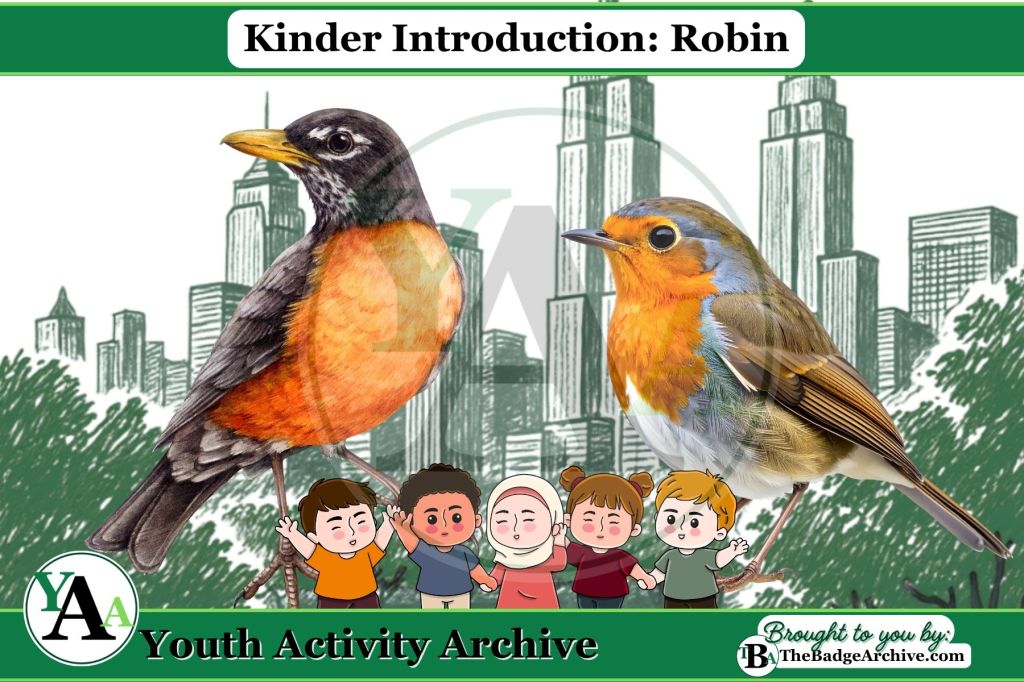
- Pictures of an American Robin and a European Robin
- Picture of a speckled juvenile bird
- (Optional) Measuring tape or 5.5‑inch and 10‑inch strings to compare sizes
- (Optional) List of American Robin Facts
- (Optional) List of European Robin Facts
Instructions (Estimated Total Time: 10–15 min):
- Meet the robin. (2–3 min)
- Look at the pictures of the American and European Robin. In the United Kingdom, the European Robin is a favorite garden bird. In North America, the American Robin is often the first sign that spring is coming.
- Notice the bright red or orange chest and round body shape. Robins are well‑known songbirds with bright red or orange chests.
- Try the “Robin Run.” (2–3 min)
- Robins find worms by running, stopping, and tilting their heads.
- Run a few steps, stop suddenly, tilt your head, and pretend to snatch a worm with your fingers.
- Learn Robin Facts. (2–3 min)
- Explain that juvenile robins have brown speckled feathers for camouflage. Young robins look different from adults and use their spotted feathers to stay hidden.
- (Optional) Use strings or a measuring tape to compare the sizes. American Robins are about 10 inches long and European Robins are about 5.5 inches long.
- Practice robin sounds and reflect. (3–4 min)
- Robins sing cheerful songs and also make short clicking sounds.
- Try different robin noises as a group: “Cheerily, cheer-up, cheerily” (American Robin song) “Tuk, tuk, tuk, teeeek!” (American Robin alarm call) “Cheep” (American Robin alarm call) “Tic” (European Robin sharp call) “Chip, chip, chip” (Sound of an American Robin chick breaking its shell) “Be” (European Robin sharp call)
- If you could sing a song to tell everyone that spring was coming, what would your song sound like?
–
For More Fun Ideas and Plans

Join the Girl Scout Daisy, Brownie, and Junior Leader Help Facebook Group
(Not an official GSUSA Group)

Join the Girl Scout Cadette, Senior, and Ambassador Leader Help Facebook Group
(Not an official GSUSA Group)

See other Recommended Facebook Groups for some Scouting Organizations
(No official Groups)
–
Click Here -> To see information References:
Disclaimer: The information published on The Badge Archive is built from the references listed below. These sources demonstrate that our content is grounded in facts and research, not opinion or speculation. Readers may consult them directly when looking for additional material.
- Fichter, George S. Cardinals, Robins, and Other Birds. New York, Golden Books, 1993.
- Girl Scouts of the U.S.A. “Meeting : 5 Flowers, 4 Stories, 3 Cheers for Animals! Pt. 2” My.girlscouts.org, Girl Scouts of the U.S.A., https://my.girlscouts.org/content/girlscouts-vtk/en/vtk.html. Accessed 23 Jan. 2026.
- Moss, Stephen. Bird-Friendly Garden. London, Harper Collins Publishers, 2000.
- Moss, Stephen. Garden Birds. London, Harper Collins Publishers Ltd., 2005.
- Posada, Mia. Robins, Songbirds of Spring. Minneapolis, Carolrhoda Books, 2004.
- Takahama, Valerie, et al. How to Guide Girl Scout Daisies through 5 Flowers, 4 Stories, 3 Cheers for Animals. Girl Scouts of the U.S.A., 2010, p. 45.
- Willis, Nancy Carol. The Robins in Your Backyard. 1996. Montchanin, Delaware, Cucumber Island Storytellers, 1997.
–
- Find out how you can support The Badge Archive!
- Choose a different Animal Kinder Introduction activity.