Activity Description: Taste and compare different “space‑safe” foods to see which ones would work best for astronauts.
Items Needed:
- 4–5 food items, including several space‑safe food items from the list (See below)
- Small plates or napkins
- (Optional) Spoons
- (Optional) Rating sheet or paper
- (Optional) Wet wipes
Before the Meeting Starts:
- Set out the food samples. (2–3 min)
- Place each food on a small plate or napkin. Label each sample with a number or name.
Instructions (Estimated Total Time: 15–20 min):
- Try each food. (10–15 min)
- Have youth taste one sample at a time.
- Youth rate the foods. (3–4 min)
- Check the Mess Factor: Does it make crumbs?
- Check Stickiness: Would it stay on a spoon if turned upside down?
- Check Nutrition: Does it seem like it would give energy?
- Compare results. (2–3 min)
- Decide which foods seem most “space‑safe” based on the three tests.
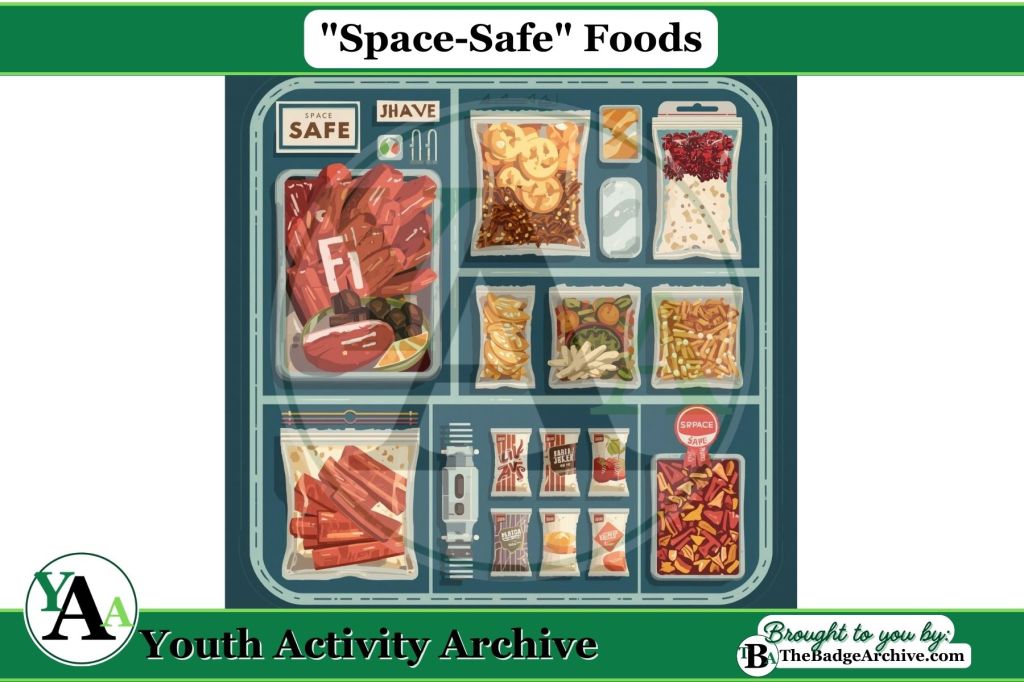
“Space-Safe” Foods
In zero gravity, crumbs are dangerous (they can be inhaled or jam equipment) and liquids don’t stay in cups. To be “Space-Safe,” a food must pass three tests:
- The Crumb Test: It must not shatter. (e.g., Use tortillas instead of bread).
- The Viscosity Test: It should be “sticky” or have a sauce so it stays on a spoon.
- The Shelf-Life Test: It must not require a refrigerator.
Grocery Store Alternatives to Freeze-Dried Food
You don’t need fancy astronaut ice cream. Most NASA food is actually just “thermostabilized” (pouched) or “natural form” food you can find at any supermarket:
- Pouched Meats: Tuna, chicken, or salmon in foil pouches (no cans needed!).
- Sticky Grains: Instant oatmeal, pudding cups, or “Ready Rice” pouches.
- Natural Form: Dried apricots, beef jerky, nuts, and granola bars (that aren’t too crumbly).
- Condiments: Small packets of ketchup, mustard, or mayo (liquid salt and pepper are used in space because grains float away!).
Sample 3-Day “Real” NASA Menu
NASA uses a 7-to-8-day “standard menu” that repeats. Here is a look at what an astronaut might eat for the first 3 days of a mission, adapted from the NASA Space Food Systems Laboratory.
| Day | Breakfast | Lunch | Dinner |
| Day 1 | Dried Cereal (add milk/water), Dried Peaches, Orange Drink. | Tuna Pouch on a Tortilla, Dried Pears, Cashews. | Beef Stew (pouch), Mashed Potatoes (rehydrated), Pudding. |
| Day 2 | Breakfast Breads, Apple Juice, Yogurt (pouch). | Chicken Salad Pouch, Whole Wheat Tortilla, Trail Mix. | Spaghetti with Meat Sauce, Green Beans with Almonds, Brownie. |
| Day 3 | Scrambled Eggs (pouch), Sausage Patties, Grapefruit Juice. | Meatball Sub (on tortilla), Cheese Spread, Dried Apricots. | Teriyaki Chicken, Rice Pilaf, Corn, Shortbread Cookies. |
–
For More Fun Ideas and Plans

Join the Girl Scout Daisy, Brownie, and Junior Leader Help Facebook Group
(Not an official GSUSA Group)

Join the Girl Scout Cadette, Senior, and Ambassador Leader Help Facebook Group
(Not an official GSUSA Group)

See other Recommended Facebook Groups for some Scouting Organizations
(No official Groups)
–
Click Here -> To see information References:
Disclaimer: The information published on Youth Activity Archive and The Badge Archive is built from the references listed below. These sources demonstrate that our content is grounded in facts and research, not opinion or speculation. Readers may consult them directly when looking for additional material.
- Lewis, Robert. “Space Food Systems.” Nasa.gov, 16 Mar. 2023, http://www.nasa.gov/directorates/esdmd/hhp/space-food-systems/. Accessed 28 Jan. 2026.
- National Aeronautics and Space Administration. “Space Food.” Nasa.gov, 2006, http://www.nasa.gov/wp-content/uploads/2015/05/167750main_fs_spacefood508c.pdf. Accessed 28 Jan. 2026.
- “Space Food.” Science Explorers, 4 Dec. 2017, scienceexplorers.com/space-food/. Accessed 28 Jan. 2026.
- Find out how you can support The Badge Archive!
Short Link: https://tinyurl.com/yc4vtdam