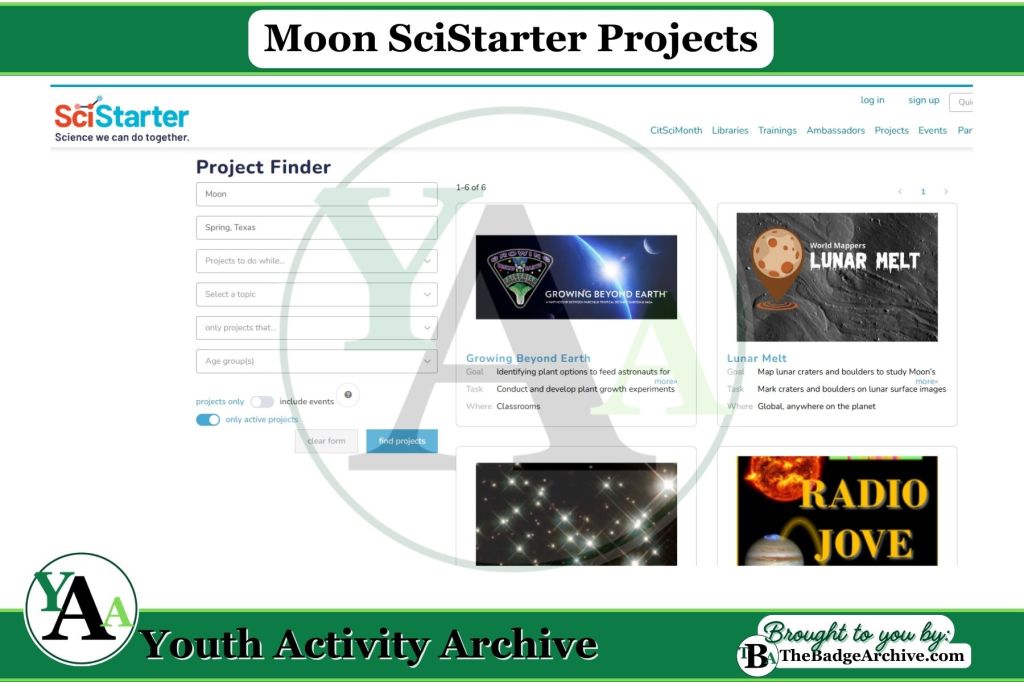
Activity Description: Choose and participate in a Moon Themed citizen‑science project from SciStarter that matches personal abilities and interests.
Items Needed:
- Computer, tablet, or phone
- Internet access
- SciStarter website
- (Optional) Notebook or paper
- (Optional) Pencil or markers
Instructions (Estimated Total Time: 10–20 min):
- Visit SciStarter. (2–3 min)
- Go to the SciStarter website and explore the list of Moon themed projects.
- Look for a project that matches abilities. (3–4 min)
- Choose a project that is simple, fun, and easy to understand.
- Read the project steps. (2–3 min)
- Choose a project that looks fun and easy to understand. Check what the project asks for and what information needs to be shared.
- If project turns out to be too complex or requires materials you do not have, go back to Step 2.
- Complete the activity. (Varies Based on Project)
- Follow the project directions, such as making observations or recording data.
- Remember to submit the information through the SciStarter project page.
Sample of Projects from January 2026:
- Moon Mappers (CosmoQuest): This is one of the most well-known lunar projects. Participants help scientists map the Moon’s surface by identifying and measuring craters in high-resolution images.
- The Goal: To create highly accurate maps that help determine the age of different lunar regions.
- The Task: Users use a web interface to “mark” the rims of craters. Because computers often struggle with the complex shadows on the Moon, human eyes are much more reliable at distinguishing real craters from other features.
- International Observe the Moon Night: While it centers on a specific annual date, SciStarter lists this as a major engagement project for lunar enthusiasts.
- The Goal: To raise awareness of lunar science and exploration.
- The Task: Participants can host or attend events, record their observations, and share photos. It is an entry-level project designed to connect the public with planetary scientists.
- Lunar Reconnaissance Orbiter (LROC) Data Classification: Several sub-projects on SciStarter involve sorting through the massive archive of LROC photos.
- The Goal: To find specific geological features like “skylights” (possible entrances to lava tubes), boulders, or evidence of recent impacts.
- The Task: You are often shown two images taken at different times to see if any new craters have appeared, or you are asked to classify the “roughness” of potential future landing sites.
- Target Moon / Transient Lunar Phenomena (TLP): These projects focus on the “changing” Moon.
- The Goal: To document rare, short-lived light flashes or color changes on the lunar surface.
- The Task: Amateur astronomers with telescopes are encouraged to monitor specific regions of the Moon and report any unusual flashes, which could be caused by meteorite impacts or outgassing.
- Globe at Night (Moon & Light Pollution): Though it focuses on stars, this project often uses the Moon as a key factor in its data collection.
- The Goal: To measure light pollution globally.
- The Task: Participants compare what they see in the night sky to charts. The phase and position of the Moon are critical data points that citizen scientists must record to ensure the light pollution measurements are accurate.
How to Participate
To get started with any of these:
- Visit the Finder: Use the link to Moon themed projects to see which are currently “Active” (accepting data).
- Create a SciStarter Dashboard: This allows you to track your contributions across different platforms (like CosmoQuest or Zooniverse) in one place.
- Low-Tech vs. High-Tech: Some projects require only a computer and an internet connection (Moon Mappers), while others (TLP) require a backyard telescope and a steady eye.
–
For More Fun Ideas and Plans

Join the Girl Scout Daisy, Brownie, and Junior Leader Help Facebook Group
(Not an official GSUSA Group)

Join the Girl Scout Cadette, Senior, and Ambassador Leader Help Facebook Group
(Not an official GSUSA Group)

See other Recommended Facebook Groups for some Scouting Organizations
(No official Groups)
–
Click Here -> To see information References:
Disclaimer: The information published on Youth Activity Archive and The Badge Archive is built from the references listed below. These sources demonstrate that our content is grounded in facts and research, not opinion or speculation. Readers may consult them directly when looking for additional material.
- This article draws solely on the author’s firsthand experience and does not incorporate outside sources.
- Find out how you can support The Badge Archive!
Short Link: https://tinyurl.com/39w7a64p