Visual arts activities help scouts explore color, shape, texture, and design while expressing their ideas and emotions.
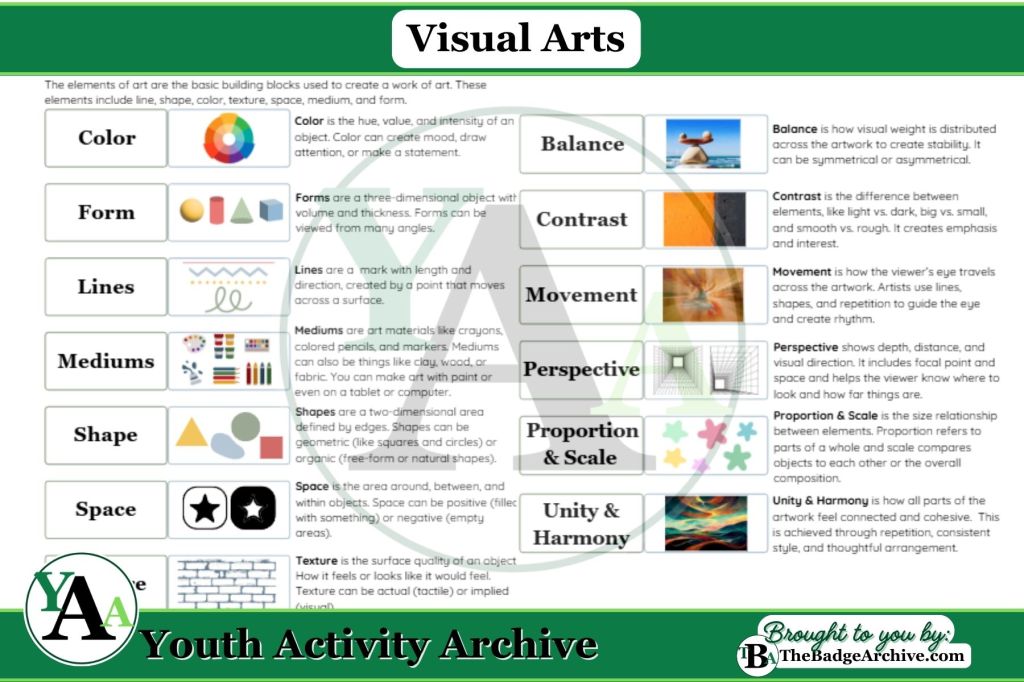
Art Elements
The basic building blocks used to create visual art.
Youth explore how each element contributes to the look, feel, and meaning of a piece. They recognize and apply foundational concepts in their own creative work.
- Color – The hue, value, and intensity of an object. Color can create mood, draw attention, or make a statement. (Examples: warm/cool color paintings, color mixing, mood palettes)
- Form – A three-dimensional object with volume and thickness. Forms can be viewed from many angles. (Examples: clay sculpture, paper folding, 3D construction)
- Line – A mark with length and direction, created by a point moving across a surface. (Examples: contour drawing, line-based patterns, gesture sketches)
- Medium – The materials used to make art. Mediums can include crayons, clay, fabric, paint, or digital tools. (Examples: mixed media projects, tool exploration stations, digital drawing)
- Shape – A two-dimensional area defined by edges. Shapes can be geometric or organic. (Examples: cut-paper collages, shape tracing, silhouette art)
- Space – The area around, between, and within objects. Space can be positive (filled) or negative (empty). (Examples: overlapping shapes, foreground/background exercises, spatial drawing)
- Texture – The surface quality of an object: how it feels or looks like it would feel. Texture can be actual or implied. (Examples: texture rubbings, tactile collages, layered paint)
- Value – The lightness or darkness of a color or tone. Value helps create depth, contrast, and emphasis in artwork. (Examples: shaded spheres, gradient pencil drawings, cross-hatching exercises)
Art Composition
Explore how visual elements are arranged to create.
Youth learn to recognize design principles and apply them in their own work through guided activities and creative experimentation.
- Balance – Projects that explore symmetry, asymmetry, and radial balance. (Examples: mirror painting, mandalas, collage with visual weight)
- Contrast – Projects that highlight differences in color, texture, shape, or size. (Examples: black-and-white drawing, warm vs cool color collage)
- Movement – Projects that guide the viewer’s eye across the artwork. (Examples: swirling patterns, directional lines, implied motion)
- Pattern – Projects that use repetition of shapes, colors, or motifs to create rhythm and visual interest. (Examples: tessellation art, repeating stamp prints, geometric pattern collages)
- Perspective – Projects that show depth or viewpoint. (Examples: horizon line landscapes, one-point perspective drawing)
- Proportion & Scale – Projects that compare size relationships. (Examples: oversized portraits, miniature dioramas)
- Symmetry – Projects that highlight mirrored or balanced designs, showing how reflection creates harmony. (Examples: folded symmetry prints, mandalas, bilateral drawing exercises)
- Unity & Harmony – Projects that create a sense of completeness or cohesion. (Examples: color family collages, repeating motifs)
Artist Studies
Projects inspired by real artists, illustrators, or media creators.
Youth explore style, technique, and personal expression. These projects help youth recognize artistic choices, experiment with techniques, and create their own work inspired by others.
- Animation & Studio Art Styles – Projects that mimic the visual style of animated films, TV shows, or studio design. (Examples: Pixar (emotion and movement), Studio Ghibli (nature and detail), Disney (character design and color), stop-motion styles)
- Cartoonists & Comic Artists – Projects inspired by comic strips, graphic novels, or stylized character art. (Examples: Charles Schulz (Peanuts), Raina Telgemeier (Smile), manga artists, webcomic creators)
- Cultural & Folk Artists – Projects inspired by traditional art forms or artists rooted in cultural heritage. (Examples: Indigenous beadwork, Mexican papel picado, African textile patterns, Aboriginal dot painting)
- Fine Artists – Projects inspired by traditional or contemporary visual artists known for painting, sculpture, or design. (Examples: Vincent van Gogh (brushwork and color), Alma Thomas (color and pattern), Yayoi Kusama (dots and repetition), Georgia O’Keeffe (scale and form))
- Illustrators & Picture Book Artists – Projects based on artists who illustrate children’s books or graphic novels. (Examples: Eric Carle (collage), Deborah Diesen’s illustrator (emotion and expression), Mo Willems (line and character), Christian Robinson (shape and simplicity))
–
For More Fun Ideas and Plans

Join the Girl Scout Daisy, Brownie, and Junior Leader Help Facebook Group
(Not an official GSUSA Group)

Join the Girl Scout Cadette, Senior, and Ambassador Leader Help Facebook Group
(Not an official GSUSA Group)

See other Recommended Facebook Groups for some Scouting Organizations
(No official Groups)
–
Click Here -> To see information References:
Disclaimer: The information published on Youth Activity Archive and The Badge Archive is built from the references listed below. These sources demonstrate that our content is grounded in facts and research, not opinion or speculation. Readers may consult them directly when looking for additional material.
- Bang, Molly. Picture This: How Pictures Work. Chronicle Books, 2010.
- Brommer, Gerald F. Drawing Ideas, Materials and Techniques. edited by George F. Horn and Sarita R. Rainey, Revised Edition ed., Worcester, Massachusetts, David Publications, Inc., 1978.
- Burns, Marilyn, and Gordon Silveria. The Greedy Triangle. Scholastic, 1994.
- Denos, Julia. Swatch: The Girl Who Loved Color. Balzer + Bray, 2016.
- Greene, Rhonda Gowler. When a Line Bends… A Shape Begins. Houghton Mifflin Harcourt, 2001.
- Hall, Michael. Perfect Square. Greenwillow Books, 2011.
- Hahn, Sabrina. ABCs of Art. Simon & Schuster, 2019.
- Krysa, Danielle. How to Spot an Artist: This Might Get Messy. Prestel Publishing, 2020.
- Leedy, Loreen. Seeing Symmetry. Holiday House, 2013.
- Mateu-Mestre, Marcos. Framed Perspective. Vol. 2: Technical Drawing for Shadows, Volume and Characters. Design Studio Press, 2016.
- Metzger, Phil. The Art of Perspective. Penguin, 2007.
- Norling, Ernest R. Perspective Made Easy. Courier Corporation, 2012.
- Raczka, Bob. Art Is… Millbrook Press, 2003.
- Reynolds, Peter H. The Dot. Candlewick Press, 2021.
- Roberts, Ian. Mastering Composition: Techniques and Principles to Dramatically Improve Your Painting. North Light Books, 2008.
- Verde, Susan. Hey, Wall. Simon & Schuster, 2018.
- Walsh, Ellen Stoll. Mouse Paint. Houghton Mifflin Harcourt, 1995.
- Walsh, Ellen Stoll. Mouse Shapes. Houghton Mifflin Harcourt, 2007.
- Watt, Fiona. The Usborne Book of Art Ideas. Usborne, 2000.
- Whitman, Candace. Lines That Wiggle. Blue Apple Books, 2009.
- Find out how you can support The Badge Archive!
- Return to the Main Categories