THIS LIST IS UNDER CONSTRUCTION – we are moving all activities from The Badge Archive to the Youth Activity Archive to make it easier to sort and find the activity you are looking for.
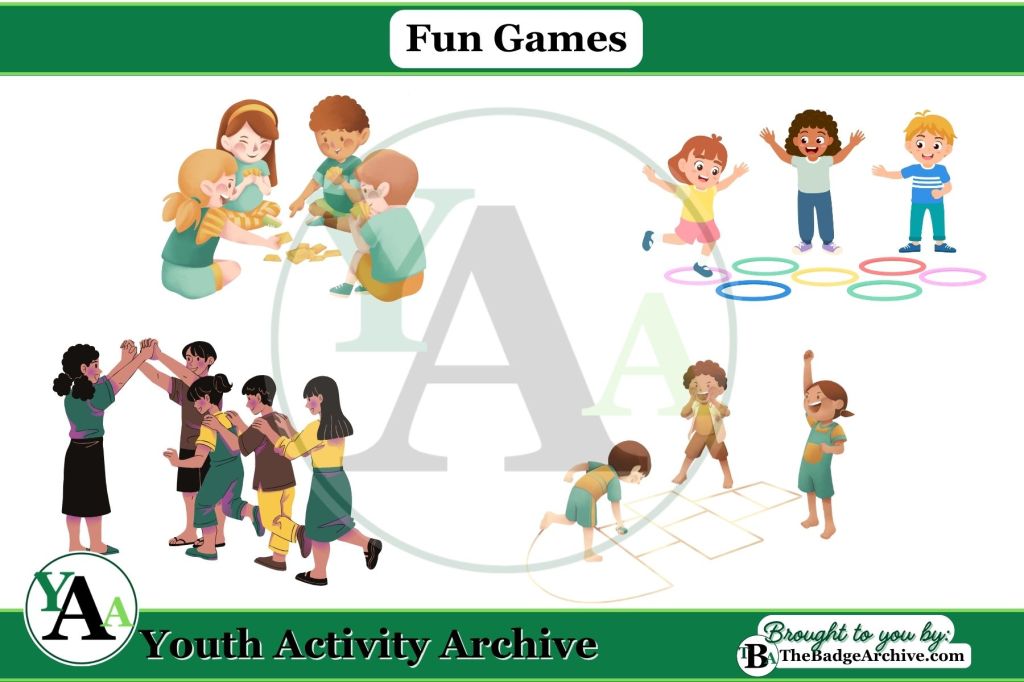
There are a lot of different games youth can play. Either as part of earning a scout badge, a classroom lesson, an adventure, or just to have some fun. Some help to get to know each other or to build teamwork. Even just to get youth moving and get some wiggles out.
Read Tips to Lead Successful Games and How to Distribute Teams
–
There are four categories of games based on how they are played:
- Conversation Games: Games that focus talking with minimal or no movement.
- Movement Games – Games and challenges that get bodies moving.
- Pick-Up Games: Easy games you can play anytime without preparation.
- Set-Up Games: More organized games that need planning or prep.
- Simple Prop Games: Fun games using basic items – (like a ball, pen and paper, or printouts).
- Singing Games: Games paired with a song.
Special Lists:
- Circle Movement Games – To play in a limited open space while sitting or standing in a circle. (Older Version)
- Getting-to-Know-You Games – To help youth learn meaningful things about each other. (Older Version)
- Icebreaker Games – To reduce initial awkwardness and help youth feel more comfortable in a group. (Older Version)
- Team Building Games – To strengthen group cooperation and problem-solving. (Older Version)
Winning or Losing
In any group of youth, especially a lively bunch of elementary aged youth, games can be a fantastic way to teach teamwork and have fun. But with young kids, it’s important to set the right tone about winning and losing. Sure, winning is exciting, and it’s natural to want to win. But we also need to help them understand that losing isn’t the end of the world. It’s okay to feel disappointed, and it’s all part of playing the game. What really matters is the fun they have and the friendships they build.
You might notice that sometimes a game gets too intense because one or two kids become overly focused on winning. That’s a good time to gently remind everyone that games are about having a good time together. Celebrate fair play and effort, and make sure no one feels left out or discouraged. Winning is great when it adds to the excitement of the game, but if it starts to spoil the fun for the group, it’s a sign to step back and reset.
Just keep the atmosphere light and playful, and the youths will naturally pick up on the idea that the joy of playing together is more important than the outcome.
Need a Specific Time Range?
- Under 10 min Games – Activity “Games” and under 10 minutes
- 10–20 min Games – Activity “Games” in the 10–20 minute range
- 20–30 min Games – Activity “Games” in the 20–30 minute range
- 30-45 min Games – Activity “Games” in the 30–45 minute range
- 45–60 min Games – Activity “Games” in the 45–60 minute range
- 60-90 min Games – Activity “Games” in the 60-90 minute range
–
For More Fun Ideas and Plans

Join the Girl Scout Daisy, Brownie, and Junior Leader Help Facebook Group
(Not an official GSUSA Group)

Join the Girl Scout Cadette, Senior, and Ambassador Leader Help Facebook Group
(Not an official GSUSA Group)

See other Recommended Facebook Groups for some Scouting Organizations
(No official Groups)
–
Click Here -> To see information References:
Disclaimer: The information published on Youth Activity Archive and The Badge Archive is built from the references listed below. These sources demonstrate that our content is grounded in facts and research, not opinion or speculation. Readers may consult them directly when looking for additional material.
- McEniry, Joan. Games for Girl Scouts. 1949. 2nd ed., U.S.A., Girl Scouts of the United States of America, 1969.
- Find out how you can support The Badge Archive!
- Return to the Main Categories