Activity Description: Learn about the Japanese Crane through simple movement, comparisons, and exploration of its habitat and symbolism.
Items Needed:
- Picture of a Japanese Crane
- (Optional) Picture of a wetland habitat
- (Optional) Small piece of paper to fold a simple “wish” shape
- (Optional) List of Japanese Crane Facts
Instructions (Estimated Total Time: 10–15 min):
- Meet the crane. (2–3 min)
- Because they are so special, many people think they are the national bird of Japan, but they aren’t. The Japanese pheasant is!
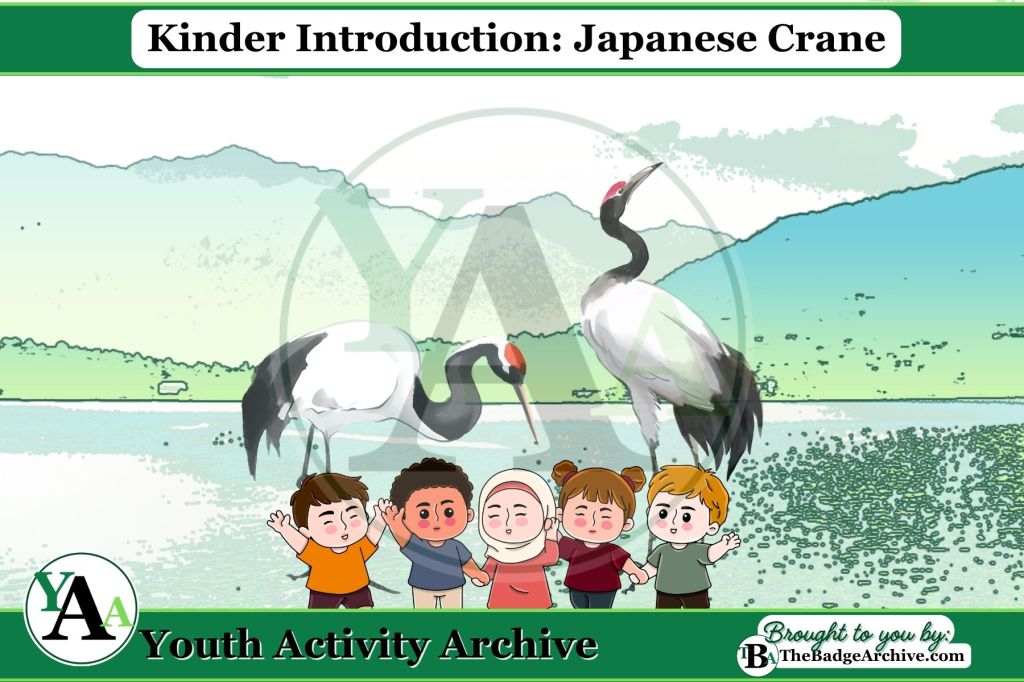
- Japanese Cranes, also called Tancho, are tall birds known for their graceful dances and long legs. Do you see the tall legs, long neck, and red spot on the head?
- A Japanese Cranes can be as tall as 5 feet. That’s as tall as most adults!
- Stand tall and stretch upward to compare their height to a crane.
- Try crane movements. (3–4 min)
- Japanese cranes are famous for having the best dance parties in the marsh.
Can you leap high into the air, bow your head, and pretend to toss grass like a crane? - Youth can leap gently, bow their heads, and pretend to toss grass like a dancing crane.
- Japanese cranes are famous for having the best dance parties in the marsh.
- Explore the crane’s home. (2–3 min)
- To find a Tancho, you have to look for places that are wet and splashy. Cranes live near rivers, ponds, wetlands, and shorelines.
- Pretend to wade slowly through water using long steps.
- Discover how cranes find food. (2–3 min)
- Cranes use their pointed beaks to catch fish or frogs.
- Pretend to search the water and gently “snap” up a snack with your fingers.
- Reflect together. (1–2 min)
- They live in wetlands and are symbols of peace, long life, and good fortune. Legends say cranes can grant wishes, and many people fold paper cranes to celebrate hope and happiness. If you could make a wish like in the crane legend, what would you wish for?
- (Optional) Folding a crane is a little complicated. Let’s try just folding a square paper three times to mimic a crane. Once in half to make a thin rectangle. One triangle upwards for the head. One triangle to the side for the tail.
–
For More Fun Ideas and Plans

Join the Girl Scout Daisy, Brownie, and Junior Leader Help Facebook Group
(Not an official GSUSA Group)

Join the Girl Scout Cadette, Senior, and Ambassador Leader Help Facebook Group
(Not an official GSUSA Group)

See other Recommended Facebook Groups for some Scouting Organizations
(No official Groups)
–
Click Here -> To see information References:
Disclaimer: The information published on The Badge Archive is built from the references listed below. These sources demonstrate that our content is grounded in facts and research, not opinion or speculation. Readers may consult them directly when looking for additional material.
- Britton, Dorothy, and Tsuneo Hayashida. The Japanese Crane: Bird of Happiness. Tokyo, New York, and San Francisco, Kodansha International, 1981.
- DuTemple, Lesley A. North American Cranes. Minneapolis, MN, Carolrhoda Books, Inc., 1999.
- Horn, Gabriel. The Crane. Mankato, MN, Crestwood House, 1988.
- Hughes, Janice M. Cranes A Natural History of a Bird in Crisis. Buffalo, New York. Firefly Books. 2008.
- Stahlecker, Dale, and Martin Frentzel. Seasons of the Crane. Heritage Assoc, 1986.
- McKenzie, Precious. Whooping Cranes. Rourke Publishing LLC, 2010.
- Takahama, Valerie, et al. How to Guide Girl Scout Daisies through 5 Flowers, 4 Stories, 3 Cheers for Animals. Girl Scouts of the U.S.A., 2010, p. 83.
- Voeller, Edward A. The Red-Crowned Crane. Minneapolis, MN, Dillon Press, 1989.
–
- Find out how you can support The Badge Archive!
- Choose a different Animal Kinder Introduction activity.