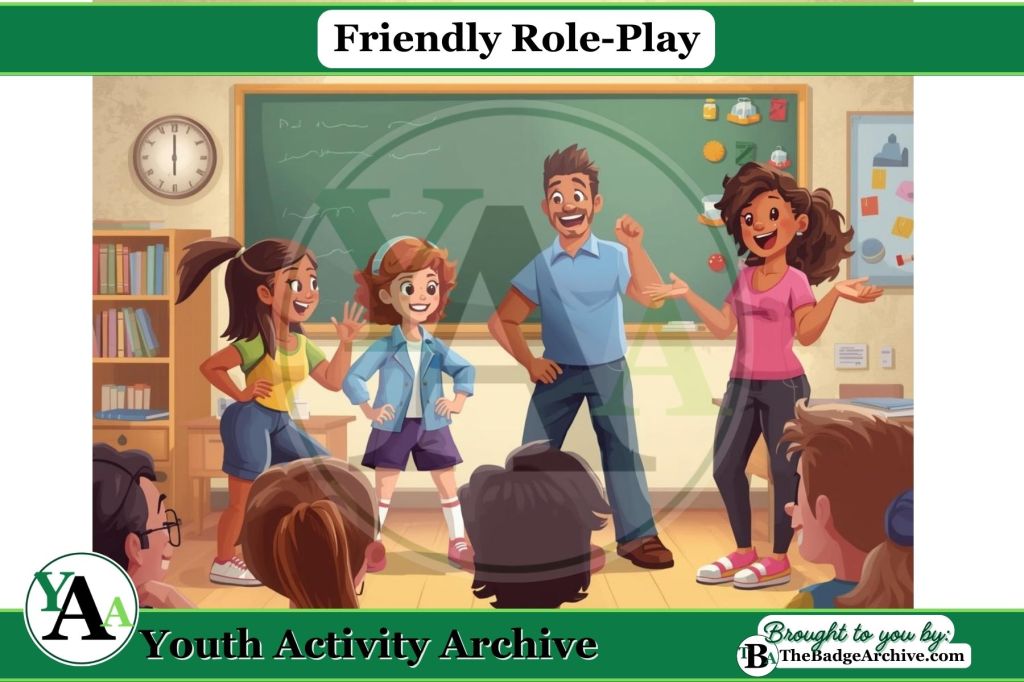
Activity Description: Youth learn what it means to be friendly and practice it through simple role‑playing scenarios.
Items Needed:
- List of role‑playing scenarios (See possible list below activity instructions)
- (Optional) Open space for groups to act out scenes
Instructions (Estimated Total Time: 10–25 min):
- Explain what friendliness means. (3–4 min)
- Describe friendliness as being kind, helpful, welcoming, and respectful to everyone. Give simple examples of friendly actions.
- Divide into small groups. (2–3 min)
- Keep youth with their adult partners and divide them into small teams. Assign one scenario to each team.
- Act out the scenarios. (5–15 min)
- Teams perform short role‑plays showing how to be friendly in front of everyone.
- Ask everyone how the team showed friendliness after each role-play. Invite ideas for other friendly actions they could take.
Scenarios
Helping & Caring
- A youth can’t reach something on a shelf. How can you help?
- Someone drops their crayons. How can you help?
- A youth is feeling sad. How can you cheer them up?
- A youth spills their snack or water. What can you do?
- A youth is having trouble putting on their jacket. How can you assist?
- A youth is nervous to try something new. How can you encourage them?
Sharing & Taking Turns
- There is only one marker of a popular color. How can you take turns?
- Two youth want the same toy. How can you share?
- Two youth want to sit in the same spot. How can you solve it kindly?
- A youth wants to join your game. How can you include them?
Kind Words & Respect
- Someone says something you disagree with. How can you respond kindly?
- A youth makes a mistake. What friendly words can you use?
- Someone accidentally bumps into you. How can you respond kindly?
- A youth shows you something they made. How can you respond in a friendly way?
- Someone compliments you. How do you respond politely?
Friendship & Inclusion
- A new youth joins the group. How can you make them feel welcome?
- A youth is shy and not talking. How can you help them feel comfortable?
- A youth is playing alone at recess. How can you invite them to join?
- A youth is new to the routine and doesn’t know what to do next. How can you guide them?
Problem Solving & Cooperation
- Two youth want to be the leader of a game. How can you help them take turns?
- A group project needs helpers. How can you work together?
- A friend needs help carrying something heavy. What can you do?
- Two youth are arguing. How can you help them get along?
- A youth is frustrated because something isn’t working. How can you support them?
Politeness & Manners
- Someone gives you a snack or shares a toy. How do you show appreciation?
- A youth doesn’t know how to play a game. How can you teach them?
- You need help from an adult or youth. How do you ask politely?
- You accidentally interrupt someone. How can you fix it kindly?
–
Click Here -> See what GSUSA Requirements could be met
Leaders – please be aware of double dipping and make your own informed choice.
Info Needed for Considerate and Caring: Practice being considerate and caring with friends.
- Fulfills Step 2 of GSUSA Daisy Petal – Considerate and Caring badge requirements.
Info Needed Friendly and Helpful: Practice being friendly and helpful at Girl Scouts
- Fulfills Step 2 of GSUSA Daisy Petal – Friendly and Helpful badge requirements.
Click Here -> See what Scouting America Requirements could be met
Leaders – please be aware of double dipping and make your own informed choice.
Info Needed: Read the Scout Law AND show how you can be trustworthy, helpful, or friendly.
- Fulfills Step 2 of Lions Bobcat Lion requirements.
- Fulfills Step 3 of Tiger Bobcat Tiger requirements.
–
For More Fun Ideas and Plans

Join the Girl Scout Daisy, Brownie, and Junior Leader Help Facebook Group
(Not an official GSUSA Group)

Join the Girl Scout Cadette, Senior, and Ambassador Leader Help Facebook Group
(Not an official GSUSA Group)

See other Recommended Facebook Groups for some Scouting Organizations
(No official Groups)
–
Click Here -> To see information References:
Disclaimer: The information published on Youth Activity Archive and The Badge Archive is built from the references listed below. These sources demonstrate that our content is grounded in facts and research, not opinion or speculation. Readers may consult them directly when looking for additional material.
- “Lion Bobcat Den Meeting Plan: Free Ideas for 2025.” Scouter Mom, 27 Nov. 2025, scoutermom.com/50031/lion-bobcat-den-meeting-plan/. Accessed 19 Dec. 2025.
- Find out how you can support The Badge Archive!
- Return to the Friendly Category