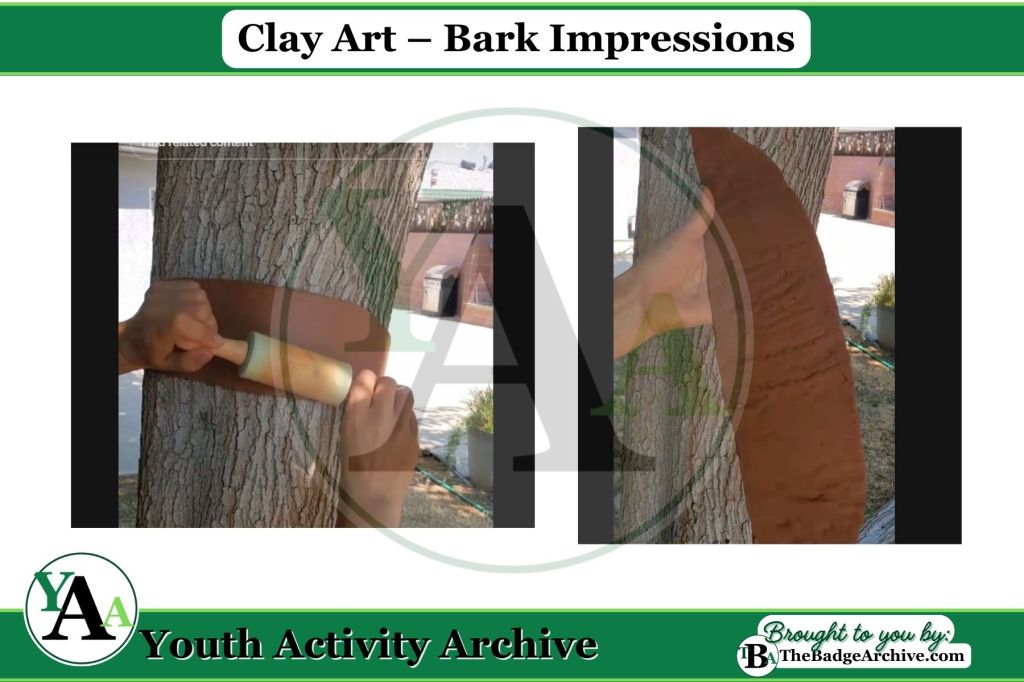
Activity Description: Youths make clay impressions of tree bark to record and compare bark patterns.
Items Needed:
- Air-Dry Clay or Modeling Clay
- Rolling pin
- (Optional) Clipboard or board to carry clay sheets
Instructions (Estimated Total Time: 20–40 min plus drying time):
- Roll out Air-Dry Clay. (3–4 min)
- Youth flatten Air-Dry Clay into a sheet using a rolling pin.
- Press clay onto tree bark. (4–6 min)
- Youth press the Air-Dry Clay firmly against the tree trunk.
- Use the rolling pin to roll the clay into the bark fully. Make sure the bark texture leaves a clear impression.
- Peel clay off the tree. (2–3 min)
- Carefully lift the Air-Dry Clay to keep the molded texture intact. This impression is a negative mold.
- Compare bark impressions. (5–15 min)
- Repeat the steps with different trees.
- Youth look at the impressions together and notice how bark textures are different.
- (Optional) Create Permanent Casts. (2–3 days)
- If using Air-Dry Clay, set impressions aside and allow them to dry for 2–3 days until hardened. Then follow the instructions for Bark Casting.
Step-by-Step Tutorials:
Video: Tik Tok by Sassygcrafts: Tree bark texture on clay – See how to roll the clay against the bark to make an impression.
–
Click Here -> See what GSUSA Requirements could be met
Leaders – please be aware of double dipping and make your own informed choice.
Info Needed for Art with Nature: Project uses nature directly in the process: through materials (like rocks, leaves, or soil), outdoor spaces, or natural forces (like sunlight or wind). The art may be built outside, designed for nature, or shaped by it.
- Fulfills Step 5 of GSUSA Daisy badge requirements.
- Fulfills Step 5 of GSUSA Brownie Outdoor Art Creator badge requirements.
- Fulfills Step 5 of GSUSA Junior Outdoor Art Explorer badge requirements.
- Fulfills Step 5 of GSUSA Cadette Outdoor Art Apprentice badge requirements.
- Fulfills Step 5 of GSUSA Senior Outdoor Art Expert badge requirements.
- Fulfills Step 5 of GSUSA Ambassador Outdoor Art Master badge requirements.
Info Needed for Nature Inspired Art Projects: Project creates something that reflects nature’s colors, patterns, themes, or messages. The materials can be anything (fabric, clay, recycled items) but the idea comes from nature. It’s about expressing how nature makes them feel or what it reminds them of.
- Fulfills Step 3 of GSUSA Daisy Outdoor Art Maker badge requirements.
- Fulfills Step 2of GSUSA Brownie Outdoor Art Creator badge requirements.
- Fulfills Step 2 of GSUSA Junior Outdoor Art Explorer badge requirements.
- Fulfills Step 2 of GSUSA Cadette Outdoor Art Apprentice badge requirements.
- Fulfills Step 2 of GSUSA Senior Outdoor Art Expert badge requirements.
- Fulfills Step 2 of GSUSA Ambassador Outdoor Art Master badge requirements.
Info Needed for Art and Design Brownie Step 2 and Junior Step 3: Texture in a drawing helps us imagine how things would feel if we could touch them. For example, a drawing of a fluffy cat looks soft and furry, while a drawing of a rough rock looks bumpy. When you touch a 3D sculpture, you can feel if it’s smooth, rough, bumpy, or soft. This helps you understand what the artwork is supposed to be, like a rough tree bark or a smooth, shiny car.
Brownie Art and Design Step 3 requires focus on Shape and Form, Space, Patterns, or Symmetry.
- Fulfills Steps 2 and 3 of GSUSA Brownie Art and Design badge requirements.
- Fulfills Step 3 of GSUSA Junior Art and Design badge requirements.
This activity does not meet any Scouting America Requirements
–
For More Fun Ideas and Plans

Join the Girl Scout Daisy, Brownie, and Junior Leader Help Facebook Group
(Not an official GSUSA Group)

Join the Girl Scout Cadette, Senior, and Ambassador Leader Help Facebook Group
(Not an official GSUSA Group)

See other Recommended Facebook Groups for some Scouting Organizations
(No official Groups)
–
Click Here -> To see information References:
Disclaimer: The information published on Youth Activity Archive and The Badge Archive is built from the references listed below. These sources demonstrate that our content is grounded in facts and research, not opinion or speculation. Readers may consult them directly when looking for additional material.
- sassygcrafts. “Tree Bark Texture on Clay.” Tiktok.com, 17 Sept. 2024, http://www.tiktok.com/@sassygcrafts/video/7415620829540551979. Accessed 22 Nov. 2025.
- Find out how you can support The Badge Archive!
- Return to the Clay Art Category