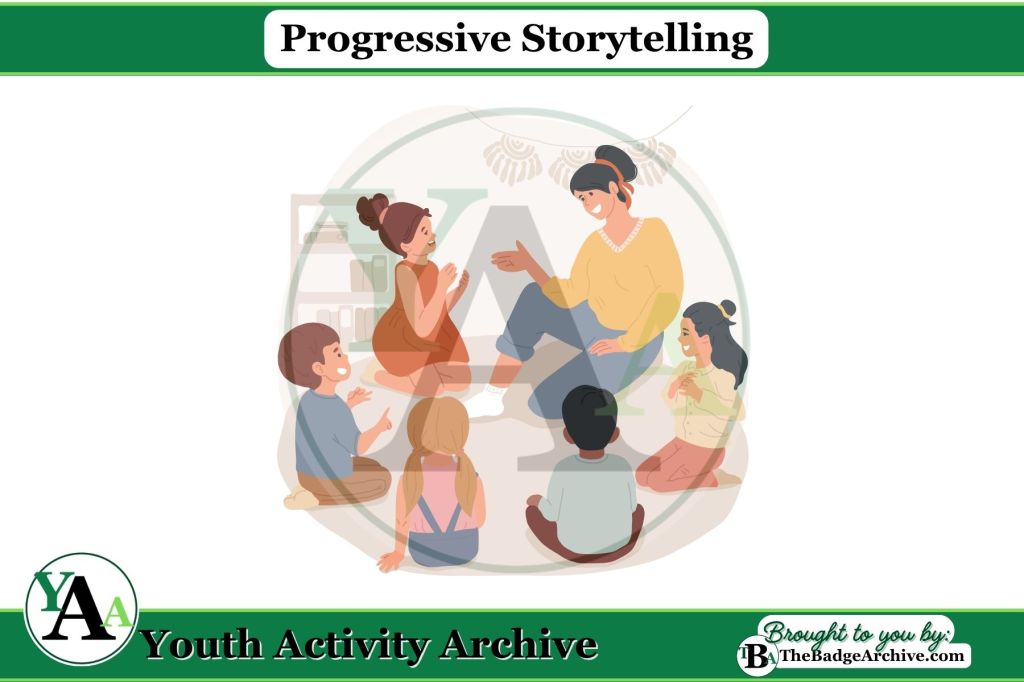
Activity Description: Youths collectively create a story by adding one sentence each.
Items Needed:
- None (just the group and their creativity!)
Instructions (Estimated Total Time: 10–15 min):
- Begin the story with one line (1–2 min)
- Sit in a circle as a group. Make sure everyone can see and hear each other.
- Choose one Youth or leader to start the story.
- The leader begins the story by saying the first line of a fictional, improvised story.
- End the line with “then suddenly!”
- Continue the story around the circle (6–8 min)
- Each Youth adds one line to the story and ends with “then suddenly!”
- Repeat or wrap up (2–3 min)
- Repeat as many times as you like to build the story.
- (Optional) End with a final line that wraps up the story.
- (Optional) Read the full story aloud or save it for later.
Variations
- No Phrase Requirement: Remove “then suddenly” altogether and have the next Scout continue the story naturally from where the previous Scout left off.
- Sentence Limit: Limit each Scout to one or two sentences before passing the story to the next person. This keeps the storytelling concise and dynamic.
- Use a Timer: Set a timer (e.g., 10 or 15 seconds) for each Scout to contribute to the story. If they don’t finish within the time, the next Scout picks up where they left off.
- Change Directions: Occasionally switch the order in which Scouts contribute (clockwise or counterclockwise) to keep things unpredictable.
- Add Themes: Assign a theme for the story, such as “space adventure” or “lost in the jungle,” and encourage Scouts to stick to it.
- Include Props: Use a prop like a ball or stick that is passed to the next Scout when it’s their turn to contribute. This adds a physical element to the activity.
- Story Genre Challenge: Introduce a new genre after each full round, like “mystery,” “comedy,” or “fantasy,” and have Scouts continue the story in that style.
- Add Restrictions: Include fun restrictions like “no names,” “only action scenes,” or “keep the story rhyming” for added creativity.
- Silent Storytelling: Have Scouts act out their part of the story instead of speaking, letting others guess what’s happening.
- Group Finale: After the story has gone around the circle, everyone contributes one final sentence together to conclude the tale.
–
For More Fun Ideas and Plans

Join the Girl Scout Daisy, Brownie, and Junior Leader Help Facebook Group
(Not an official GSUSA Group)

Join the Girl Scout Cadette, Senior, and Ambassador Leader Help Facebook Group
(Not an official GSUSA Group)

See other Recommended Facebook Groups for some Scouting Organizations
(No official Groups)
–
Click Here -> To see information References:
Disclaimer: The information published on Youth Activity Archive and The Badge Archive is built from the references listed below. These sources demonstrate that our content is grounded in facts and research, not opinion or speculation. Readers may consult them directly when looking for additional material.
- “10 Awesome Ice Breaker Activities for Elementary School Girls – Girl Scouts of Western Ohio Blog.” Girl Scouts of Western Ohio Blog – Building Girls of Courage, Confidence, and Character., 18 Nov. 2019, gswoblog.org/2019/11/18/10-awesome-ice-breaker-activities-for-elementary-school-girls/. Accessed 22 Feb. 2025.
- Find out how you can support The Badge Archive!
- Return to the Fun Games Categories.